Débora Ferreira dos Santos Morais , José Luis Tirado , Carlos Pérez-Vicente , Fabiana Villela da Motta , Pedro Lavela , Mauricio Bomio , Sergio Lavela
{"title":"Unlocking the performance of sodium-ion batteries by coating Na3V2(PO4)3 with Nb2O5","authors":"Débora Ferreira dos Santos Morais , José Luis Tirado , Carlos Pérez-Vicente , Fabiana Villela da Motta , Pedro Lavela , Mauricio Bomio , Sergio Lavela","doi":"10.1016/j.actphy.2025.100180","DOIUrl":null,"url":null,"abstract":"<div><div>Na<sub>3</sub>V<sub>2</sub>(PO<sub>4</sub>)<sub>3</sub> (NVP) is a promising cathode material for sodium-ion batteries owing to its NASICON-type framework, which enables efficient reversible sodium insertion. However, its practical performance is limited by slow charge transfer at high cycling rates and cycling instability. Here, we report a facile impregnation method to deposit Nb<sub>2</sub>O<sub>5</sub> on NVP particles, aiming to enhance high-rate capability and long-term cycling stability. Structural and spectroscopic analyses (XRD, electron microscopy, Raman, XPS, and X-ray fluorescence spectroscopy) confirm the crystallinity of NVP and the uniform presence of Nb<sub>2</sub>O<sub>5</sub> on particle surfaces without compromising sodium reversibility. Electrochemical measurements reveal that Nb<sub>2</sub>O<sub>5</sub>-coated samples show the highest diffusion coefficients, ensuring superior high-rate performance and cycling stability. The 3 % Nb<sub>2</sub>O<sub>5</sub> coating delivers the highest diffusion coefficients, superior cycling stability, and sustained capacity retention at a 1C rate. Cyclic voltammetry and impedance spectroscopy indicate enhanced surface capacitance, facilitating rapid sodium storage. XPS shows the conversion of Nb<sub>2</sub>O<sub>5</sub> into NbF<sub>5</sub>, resulting from HF scavenging, which improved interfacial stability. Extended cycling tests validate the long-term durability of the coated electrode. These results demonstrate that Nb<sub>2</sub>O<sub>5</sub> surface modification is an effective strategy to overcome the intrinsic limitations of NVP, offering a viable route to high-performance sodium-ion batteries.</div></div>","PeriodicalId":6964,"journal":{"name":"物理化学学报","volume":"42 2","pages":"Article 100180"},"PeriodicalIF":13.5000,"publicationDate":"2026-02-01","publicationTypes":"Journal Article","fieldsOfStudy":null,"isOpenAccess":false,"openAccessPdf":"","citationCount":"0","resultStr":null,"platform":"Semanticscholar","paperid":null,"PeriodicalName":"物理化学学报","FirstCategoryId":"92","ListUrlMain":"https://www.sciencedirect.com/science/article/pii/S1000681825001365","RegionNum":2,"RegionCategory":"化学","ArticlePicture":[],"TitleCN":null,"AbstractTextCN":null,"PMCID":null,"EPubDate":"2025/9/9 0:00:00","PubModel":"Epub","JCR":"Q1","JCRName":"CHEMISTRY, PHYSICAL","Score":null,"Total":0}
引用次数: 0
Abstract
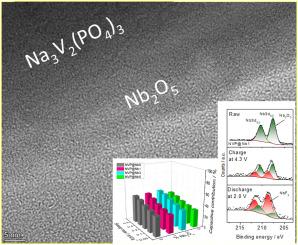
Na3V2(PO4)3 (NVP) is a promising cathode material for sodium-ion batteries owing to its NASICON-type framework, which enables efficient reversible sodium insertion. However, its practical performance is limited by slow charge transfer at high cycling rates and cycling instability. Here, we report a facile impregnation method to deposit Nb2O5 on NVP particles, aiming to enhance high-rate capability and long-term cycling stability. Structural and spectroscopic analyses (XRD, electron microscopy, Raman, XPS, and X-ray fluorescence spectroscopy) confirm the crystallinity of NVP and the uniform presence of Nb2O5 on particle surfaces without compromising sodium reversibility. Electrochemical measurements reveal that Nb2O5-coated samples show the highest diffusion coefficients, ensuring superior high-rate performance and cycling stability. The 3 % Nb2O5 coating delivers the highest diffusion coefficients, superior cycling stability, and sustained capacity retention at a 1C rate. Cyclic voltammetry and impedance spectroscopy indicate enhanced surface capacitance, facilitating rapid sodium storage. XPS shows the conversion of Nb2O5 into NbF5, resulting from HF scavenging, which improved interfacial stability. Extended cycling tests validate the long-term durability of the coated electrode. These results demonstrate that Nb2O5 surface modification is an effective strategy to overcome the intrinsic limitations of NVP, offering a viable route to high-performance sodium-ion batteries.

 求助内容:
求助内容: 应助结果提醒方式:

 京公网安备 11010802042870号


