
Improving a low frequency EPR spectrometer using field-programmable gate array enabled direct digital detection

IF 2.624
Journal of Magnetic Resonance Open Pub Date : 2025-12-01 Epub Date: 2025-11-01 DOI:10.1016/j.jmro.2025.100212
Joseph P. Hornak , James D. Phillips , Arash Fereidouni
{"title":"Improving a low frequency EPR spectrometer using field-programmable gate array enabled direct digital detection","authors":"Joseph P. Hornak ,&nbsp;James D. Phillips ,&nbsp;Arash Fereidouni","doi":"10.1016/j.jmro.2025.100212","DOIUrl":null,"url":null,"abstract":"<div><div>Field-programmable gate array (FPGA) enabled direct digital detection (DDD) at higher frequencies is becoming increasingly available and popular due to the high-speed real-time signal processing. Consequently, it is opening up new possibilities for digital rather than analog demodulation, filtering, quadrature detection, and general signal processing that can reduce the spectrometer noise associated with thermal drift, aging, and layout of the equivalent analog detection chain. This article presents the result of a comparison of the low-frequency electron paramagnetic resonance (LFEPR) signal-to-noise ratio for a DPPH standard on the electron paramagnetic resonance (EPR) mobile universal surface explorer (MOUSE) by two signal detection schemes. The first utilized the classic analog detection and demodulation scheme of a LFEPR spectrometer and the second utilized the Zurich Instruments ultra-high frequency lock-in (UHFLI) amplifier, which replaces most of the analog components in the LFEPR spectrometer. The UHFLI spectrometer configuration improved the signal-to-noise ratio by a factor of two, reduced the baseline drift to one eighteenth, reduced the instrument volume by 70 %, and reduced the instrument weight by 50 % compared to the values with the classic analog system.</div></div>","PeriodicalId":365,"journal":{"name":"Journal of Magnetic Resonance Open","volume":"25 ","pages":"Article 100212"},"PeriodicalIF":2.6240,"publicationDate":"2025-12-01","publicationTypes":"Journal Article","fieldsOfStudy":null,"isOpenAccess":false,"openAccessPdf":"","citationCount":"0","resultStr":null,"platform":"Semanticscholar","paperid":null,"PeriodicalName":"Journal of Magnetic Resonance Open","FirstCategoryId":"1","ListUrlMain":"https://www.sciencedirect.com/science/article/pii/S2666441025000287","RegionNum":0,"RegionCategory":null,"ArticlePicture":[],"TitleCN":null,"AbstractTextCN":null,"PMCID":null,"EPubDate":"2025/11/1 0:00:00","PubModel":"Epub","JCR":"","JCRName":"","Score":null,"Total":0}
引用次数: 0

Abstract

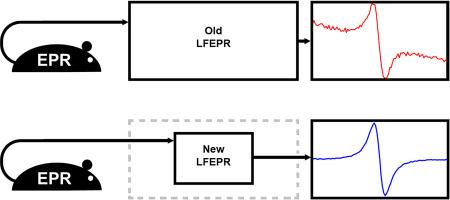
Field-programmable gate array (FPGA) enabled direct digital detection (DDD) at higher frequencies is becoming increasingly available and popular due to the high-speed real-time signal processing. Consequently, it is opening up new possibilities for digital rather than analog demodulation, filtering, quadrature detection, and general signal processing that can reduce the spectrometer noise associated with thermal drift, aging, and layout of the equivalent analog detection chain. This article presents the result of a comparison of the low-frequency electron paramagnetic resonance (LFEPR) signal-to-noise ratio for a DPPH standard on the electron paramagnetic resonance (EPR) mobile universal surface explorer (MOUSE) by two signal detection schemes. The first utilized the classic analog detection and demodulation scheme of a LFEPR spectrometer and the second utilized the Zurich Instruments ultra-high frequency lock-in (UHFLI) amplifier, which replaces most of the analog components in the LFEPR spectrometer. The UHFLI spectrometer configuration improved the signal-to-noise ratio by a factor of two, reduced the baseline drift to one eighteenth, reduced the instrument volume by 70 %, and reduced the instrument weight by 50 % compared to the values with the classic analog system.
Abstract Image

使用现场可编程门阵列改进低频EPR光谱仪,实现直接数字检测
基于现场可编程门阵列(FPGA)的高频直接数字检测(DDD)由于信号的高速实时处理而日益普及。因此,它为数字而不是模拟解调、滤波、正交检测和一般信号处理开辟了新的可能性,可以减少与热漂移、老化和等效模拟检测链布局相关的光谱仪噪声。本文介绍了两种信号检测方案在电子顺磁共振(EPR)移动式通用表面探测器(MOUSE)上对DPPH标准的低频电子顺磁共振(LFEPR)信噪比的比较结果。前者采用了LFEPR光谱仪经典的模拟检测解调方案,后者采用了苏黎世仪器的超高频锁相(UHFLI)放大器,取代了LFEPR光谱仪中的大部分模拟元件。与经典模拟系统相比,UHFLI光谱仪的配置将信噪比提高了2倍,将基线漂移降低到1 / 18,将仪器体积缩小了70%,仪器重量减少了50%。
本文章由计算机程序翻译,如有差异,请以英文原文为准。
求助全文
约1分钟内获得全文 求助全文
来源期刊
CiteScore
1.90
自引率
0.00%
发文量
0
×
引用
GB/T 7714-2015
复制
MLA
复制
APA
复制
导出至
BibTeX EndNote RefMan NoteFirst NoteExpress
×
提示
您的信息不完整,为了账户安全,请先补充。
现在去补充
×
提示
您因"违规操作"
具体请查看互助需知
我知道了
×
提示
确定
请完成安全验证×
copy
已复制链接
快去分享给好友吧!
我知道了
右上角分享
点击右上角分享
0
联系我们:info@booksci.cn Book学术提供免费学术资源搜索服务,方便国内外学者检索中英文文献。致力于提供最便捷和优质的服务体验。 Copyright © 2023 布克学术 All rights reserved.
京ICP备2023020795号-1
ghs 京公网安备 11010802042870号
Book学术文献互助
Book学术文献互助群
群 号:604180095
Book学术官方微信
小红书



