
Alternate splicing converts human CD137 from costimulatory to immunosuppressive function
IF 6.8
1区 医学
Q1 IMMUNOLOGY
引用次数: 0
Abstract
Human membrane-bound CD137 (mCD137) is a well-known costimulatory molecule; however, it is alternatively spliced into two transcripts (sCD137-1, 2) whose function is not yet known. Here, we show that sCD137 isoforms lack the CRD4 region and form unique structures compared to mCD137. Human activated Tregs produce both CD137 splice isoforms, which are rapidly upregulated after cell activation, and identify an activated Treg phenotype along with FOXP3, CTLA4, and sCTLA4. We engineered recombinant Fc-Hu-sCD137 variants, which are immunosuppressive, inhibiting IFN-γ secretion and proliferation in purified CD4+ and CD8+ T cells in an APC-independent manner. These effects are mediated by the downregulation of S6 and 4EBP1 of the mTOR complex 1 pathway. Human sCD137 variants, in contrast to the membrane-bound form, are immunosuppressive and may be a novel treatment for inflammation and autoimmunity.
交替剪接将人CD137从共刺激功能转化为免疫抑制功能
人膜结合CD137 (mCD137)是一种众所周知的共刺激分子;然而,它被选择性地拼接成两个功能尚不清楚的转录本(scd137 - 1,2)。在这里,我们发现sCD137异构体缺乏CRD4区域,与mCD137相比形成独特的结构。人类活化的Treg产生CD137剪接异构体,在细胞活化后迅速上调,并与FOXP3, CTLA4和sCTLA4一起鉴定出活化的Treg表型。我们设计了重组Fc-Hu-sCD137变体,该变体具有免疫抑制作用,以不依赖apc的方式抑制纯化CD4+和CD8+ T细胞中IFN-γ的分泌和增殖。这些作用是通过mTOR复合物1通路中S6和4EBP1的下调介导的。与膜结合形式相反,人类sCD137变体具有免疫抑制作用,可能是治疗炎症和自身免疫的一种新方法。
本文章由计算机程序翻译,如有差异,请以英文原文为准。
求助全文
约1分钟内获得全文
求助全文
来源期刊
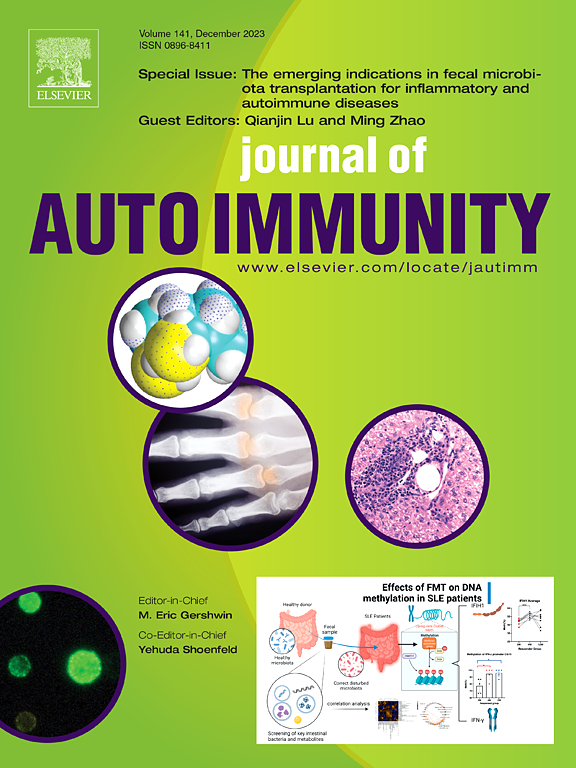
Journal of autoimmunity
医学-免疫学
CiteScore
27.90
自引率
1.60%
发文量
117
审稿时长
17 days
期刊介绍:
The Journal of Autoimmunity serves as the primary publication for research on various facets of autoimmunity. These include topics such as the mechanism of self-recognition, regulation of autoimmune responses, experimental autoimmune diseases, diagnostic tests for autoantibodies, as well as the epidemiology, pathophysiology, and treatment of autoimmune diseases. While the journal covers a wide range of subjects, it emphasizes papers exploring the genetic, molecular biology, and cellular aspects of the field.
The Journal of Translational Autoimmunity, on the other hand, is a subsidiary journal of the Journal of Autoimmunity. It focuses specifically on translating scientific discoveries in autoimmunity into clinical applications and practical solutions. By highlighting research that bridges the gap between basic science and clinical practice, the Journal of Translational Autoimmunity aims to advance the understanding and treatment of autoimmune diseases.
 求助内容:
 应助结果提醒方式:


 京公网安备 11010802042870号


