Dorian-Gabriel Muntean, Wojtek Treyde, Linda Kinena, Eidarus Salah, Hani Choudhry, Fernanda Duarte, Lennart Brewitz and Christopher J. Schofield
{"title":"C6-Alkoxy substituted penicillins are potent non-covalently binding inhibitors of the SARS-CoV-2 main protease","authors":"Dorian-Gabriel Muntean, Wojtek Treyde, Linda Kinena, Eidarus Salah, Hani Choudhry, Fernanda Duarte, Lennart Brewitz and Christopher J. Schofield","doi":"10.1039/D5MD00789E","DOIUrl":null,"url":null,"abstract":"<p >Inhibition of the SARS-CoV-2 main protease (M<small><sup>pro</sup></small>) by small-molecules is a validated strategy for COVID-19 treatment. There is a need for improved M<small><sup>pro</sup></small> inhibitors, including because M<small><sup>pro</sup></small> mutations can confer resistance to clinically used M<small><sup>pro</sup></small> inhibitors. Previous work has revealed the potential of penicillin derivatives as covalently reacting M<small><sup>pro</sup></small> inhibitors. Here we report studies on M<small><sup>pro</sup></small> inhibition by C6-alkoxy substituted penicillin derivatives. The combined mass spectrometric and computational evidence imply most of the tested penicillin C6-alkoxy derivatives bind <em>via</em> non-covalent interactions at the M<small><sup>pro</sup></small> active site, resulting in potent substrate-competitive inhibition. Some penicillin C6-alkoxy derivatives ((<em>R</em>)-, but not (<em>S</em>)-sulfoxides) manifest covalent reaction to different extents. Penicillins and related drugs are widely used antibiotics, acting <em>via</em> covalent reaction of their β-lactam with a nucleophilic serine in their transpeptidase targets to give an acyl–enzyme complex. The results imply penicillin derivatives can be developed to inhibit enzymes via mechanisms other than formation of stable acyl–enzyme complexes.</p>","PeriodicalId":21462,"journal":{"name":"RSC medicinal chemistry","volume":" 12","pages":" 6351-6367"},"PeriodicalIF":3.6000,"publicationDate":"2025-10-27","publicationTypes":"Journal Article","fieldsOfStudy":null,"isOpenAccess":false,"openAccessPdf":"https://www.ncbi.nlm.nih.gov/pmc/articles/PMC12588090/pdf/","citationCount":"0","resultStr":null,"platform":"Semanticscholar","paperid":null,"PeriodicalName":"RSC medicinal chemistry","FirstCategoryId":"3","ListUrlMain":"https://pubs.rsc.org/en/content/articlelanding/2025/md/d5md00789e","RegionNum":4,"RegionCategory":"医学","ArticlePicture":[],"TitleCN":null,"AbstractTextCN":null,"PMCID":null,"EPubDate":"","PubModel":"","JCR":"Q2","JCRName":"BIOCHEMISTRY & MOLECULAR BIOLOGY","Score":null,"Total":0}
引用次数: 0
Abstract
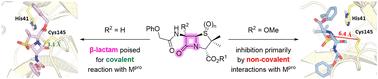
Inhibition of the SARS-CoV-2 main protease (Mpro) by small-molecules is a validated strategy for COVID-19 treatment. There is a need for improved Mpro inhibitors, including because Mpro mutations can confer resistance to clinically used Mpro inhibitors. Previous work has revealed the potential of penicillin derivatives as covalently reacting Mpro inhibitors. Here we report studies on Mpro inhibition by C6-alkoxy substituted penicillin derivatives. The combined mass spectrometric and computational evidence imply most of the tested penicillin C6-alkoxy derivatives bind via non-covalent interactions at the Mpro active site, resulting in potent substrate-competitive inhibition. Some penicillin C6-alkoxy derivatives ((R)-, but not (S)-sulfoxides) manifest covalent reaction to different extents. Penicillins and related drugs are widely used antibiotics, acting via covalent reaction of their β-lactam with a nucleophilic serine in their transpeptidase targets to give an acyl–enzyme complex. The results imply penicillin derivatives can be developed to inhibit enzymes via mechanisms other than formation of stable acyl–enzyme complexes.

 求助内容:
求助内容: 应助结果提醒方式:

 京公网安备 11010802042870号


