
20-Hydroxyecdysone promotes fat body lipolysis through autophagy during pupation in Apis mellifera
IF 2.2
2区 生物学
Q4 BIOCHEMISTRY & MOLECULAR BIOLOGY
Comparative Biochemistry and Physiology D-Genomics & Proteomics
Pub Date : 2026-03-01
Epub Date: 2025-10-24
DOI:10.1016/j.cbd.2025.101663
引用次数: 0
Abstract
20-hydroxyecdysone (20E) plays a crucial role in insect metamorphosis and has been reported to be involved in fat body lipolysis during pupation in many insects, although this has not been reported in honeybees. Here, we investigated how 20E regulates lipid metabolism during pupation in Apis mellifera. We found that 20E promotes fat body lipolysis by inducing autophagy. 20E treatment reduced fat body triglyceride (TG) content, upregulated lipase-1 and adipokinetic hormone receptor (akhr) expression, and promoted fat body lipolysis. Our lipidomic results showed that honeybee larvae treated with 20E showed significant changes in their TG and phosphatidylcholine (PC) fatty acid levels. In conclusion, we conclude that 20E promotes pupal development by coordinating autophagy and lipid mobilization. This work reveals a novel regulatory mechanism of insect metamorphosis in honeybees and expands our understanding of steroid hormone action in holometabolous insects.
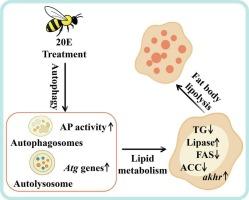
在蜜蜂化蛹过程中,羟基蜕皮激素通过自噬促进脂肪体脂解。
20-羟基蜕皮激素(20E)在昆虫的变态过程中起着至关重要的作用,据报道,在许多昆虫的化蛹过程中,20-羟基蜕皮激素参与了脂肪体的脂肪分解,尽管在蜜蜂中还没有报道。在此,我们研究了20E如何调节蜜蜂化蛹过程中的脂质代谢。我们发现20E通过诱导自噬促进脂肪体脂质分解。20E处理降低了脂肪体甘油三酯(TG)含量,上调了脂肪酶-1和脂肪动力学激素受体(akhr)的表达,促进了脂肪体脂解。脂质组学结果显示,20E处理的蜜蜂幼虫的TG和磷脂酰胆碱(PC)脂肪酸水平发生了显著变化。总之,我们认为20E通过协调自噬和脂质动员来促进蛹的发育。这项工作揭示了蜜蜂昆虫变态的一种新的调节机制,并扩大了我们对类固醇激素在全变态昆虫中的作用的理解。
本文章由计算机程序翻译,如有差异,请以英文原文为准。
求助全文
约1分钟内获得全文
求助全文
来源期刊
CiteScore
5.10
自引率
3.30%
发文量
69
审稿时长
33 days
期刊介绍:
Comparative Biochemistry & Physiology (CBP) publishes papers in comparative, environmental and evolutionary physiology.
Part D: Genomics and Proteomics (CBPD), focuses on “omics” approaches to physiology, including comparative and functional genomics, metagenomics, transcriptomics, proteomics, metabolomics, and lipidomics. Most studies employ “omics” and/or system biology to test specific hypotheses about molecular and biochemical mechanisms underlying physiological responses to the environment. We encourage papers that address fundamental questions in comparative physiology and biochemistry rather than studies with a focus that is purely technical, methodological or descriptive in nature.
 求助内容:
求助内容: 应助结果提醒方式:

 京公网安备 11010802042870号


