
Quantum AI-Enhanced IoT–Fog Communication: A Survey From Cybersecurity and Data Privacy Perspective
IF 50.6
1区 计算机科学
Q1 COMPUTER SCIENCE, INFORMATION SYSTEMS
IEEE Communications Surveys and Tutorials
Pub Date : 2026-01-01
Epub Date: 2025-10-20
DOI:10.1109/COMST.2025.3622378
引用次数: 0
Abstract
The need for data privacy in the next-generation communication networks encompassing the Internet of Things (IoT) and Fog infrastructure has become very significant. This enforces the need for Quantum Artificial Intelligence (AI) approaches to safeguard them. The evolving new means of threats, which are complex and challenging to predict, make conventional security solutions difficult to address and mitigate. To counteract them proactively and efficiently, most organizations have started using AI solutions, which analyze and predict patterns of threats. However, most recent threats demand more robust solutions integrated into the network infrastructure. To sort out most of the demands of IoT-Fog communication services, we present a comprehensive review of Quantum AI to provide a secure and robust framework. Specifically, we provide a taxonomy to summarize the studies on Quantum AI over the IoT-Fog infrastructure, intended to provide predictive maintenance, mitigating threats, and robust defense strategies. Furthermore, we propose the integration of Neurosymbolic AI, which combines the pattern recognition power of neural networks with the reasoning capabilities of symbolic systems, thereby enabling context-aware threat detection and explainable decision-making in critical infrastructure security. In addition, we also emphasize network protocol security and communication privacy issues, particularly in industrial and cyber-physical system networks. Finally, we discuss prominent research challenges and open-ended future research directions for Quantum AI in next-generation wireless networks.量子ai增强物联网雾通信:网络安全和数据隐私视角的研究
在包括物联网(IoT)和雾基础设施的下一代通信网络中,对数据隐私的需求已经变得非常重要。这就需要量子人工智能(AI)方法来保护它们。不断发展的新威胁手段既复杂又难以预测,使得传统的安全解决方案难以应对和缓解。为了主动有效地应对这些威胁,大多数组织已经开始使用人工智能解决方案,分析和预测威胁的模式。然而,大多数最新的威胁需要更强大的解决方案集成到网络基础设施中。为了理清物联网雾通信服务的大部分需求,我们对量子人工智能进行了全面的回顾,以提供一个安全可靠的框架。具体来说,我们提供了一个分类法来总结在物联网雾基础设施上的量子人工智能研究,旨在提供预测性维护,减轻威胁和强大的防御策略。此外,我们提出了神经符号人工智能的集成,它将神经网络的模式识别能力与符号系统的推理能力相结合,从而在关键基础设施安全中实现上下文感知威胁检测和可解释决策。此外,我们还强调网络协议安全和通信隐私问题,特别是在工业和网络物理系统网络中。最后,我们讨论了下一代无线网络中量子人工智能的突出研究挑战和开放式未来研究方向。
本文章由计算机程序翻译,如有差异,请以英文原文为准。
求助全文
约1分钟内获得全文
求助全文
来源期刊
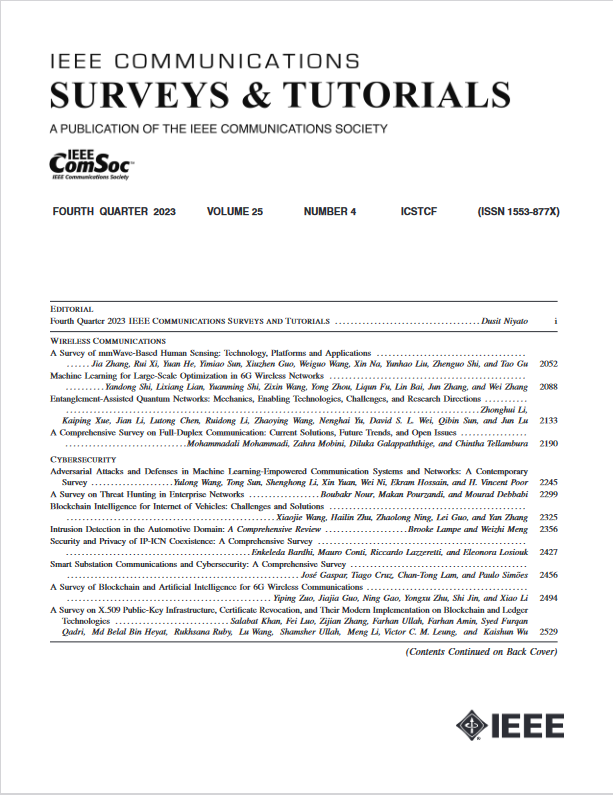
IEEE Communications Surveys and Tutorials
COMPUTER SCIENCE, INFORMATION SYSTEMS-TELECOMMUNICATIONS
CiteScore
80.20
自引率
2.50%
发文量
84
审稿时长
6 months
期刊介绍:
IEEE Communications Surveys & Tutorials is an online journal published by the IEEE Communications Society for tutorials and surveys covering all aspects of the communications field. Telecommunications technology is progressing at a rapid pace, and the IEEE Communications Society is committed to providing researchers and other professionals the information and tools to stay abreast. IEEE Communications Surveys and Tutorials focuses on integrating and adding understanding to the existing literature on communications, putting results in context. Whether searching for in-depth information about a familiar area or an introduction into a new area, IEEE Communications Surveys & Tutorials aims to be the premier source of peer-reviewed, comprehensive tutorials and surveys, and pointers to further sources. IEEE Communications Surveys & Tutorials publishes only articles exclusively written for IEEE Communications Surveys & Tutorials and go through a rigorous review process before their publication in the quarterly issues.
A tutorial article in the IEEE Communications Surveys & Tutorials should be designed to help the reader to become familiar with and learn something specific about a chosen topic. In contrast, the term survey, as applied here, is defined to mean a survey of the literature. A survey article in IEEE Communications Surveys & Tutorials should provide a comprehensive review of developments in a selected area, covering its development from its inception to its current state and beyond, and illustrating its development through liberal citations from the literature. Both tutorials and surveys should be tutorial in nature and should be written in a style comprehensible to readers outside the specialty of the article.
 求助内容:
 应助结果提醒方式:


 京公网安备 11010802042870号


