
Novel 3D polyethyleneimine functionalized konjac glucomannan aerogel for selective removal of anionic dye from water
IF 3.6
3区 化学
Q2 CHEMISTRY, INORGANIC & NUCLEAR
Solid State Sciences
Pub Date : 2025-12-01
Epub Date: 2025-10-22
DOI:10.1016/j.solidstatesciences.2025.108107
引用次数: 0
Abstract
The severe environmental pollution and ecological risks caused by dyeing wastewater are currently issues that need to be urgently addressed. Herein, a novel environmental-friendly ternary hybrid aerogel (KGP), composed of konjac glucomannan (KGM), ghatti gum (GG), and polyethyleneimine (PEI), was designed and simply fabricated for the highly efficient and selective removal of methyl orange (MO) from water. The structure and composition of KGP-2 were characterized using SEM, FT-IR, XRD, and XPS. The effects of PEI content, pH, contact time, and temperature on MO sorption were systematically investigated. The experimental maximum adsorption capacity of KGP-2 was 135.39 mg/g, which was three times higher than that of KGM/GG aerogel (43.8 mg/g). With the integration of the adsorption kinetics, isotherms, and thermodynamic studies, along with the various spectroscopic characterizations before and after adsorption, the adsorption mechanisms of KGP-2 for MO were investigated in detail. Selective adsorption tests demonstrated the high selectivity of KGP-2 for MO, and after six cycles of adsorption-desorption, the MO removal rate remained above 80 %, highlighting the stability and reusability of KGP-2. Consequently, this newly developed composite aerogel is expected to serve as a highly promising sorbent for the adsorptive removal of MO from practical water systems.
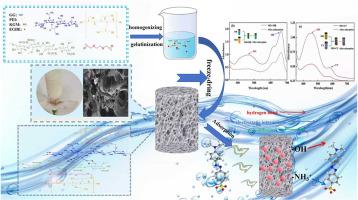
新型三维聚乙烯亚胺功能化魔芋葡甘露聚糖气凝胶用于水中阴离子染料的选择性去除
印染废水对环境的严重污染和生态风险是目前急需解决的问题。以魔芋葡甘露聚糖(KGM)、加蒂胶(GG)和聚乙烯亚胺(PEI)为原料,设计制备了一种新型的环境友好型三元杂化气凝胶(KGP),用于高效、选择性地去除水中的甲基橙(MO)。采用SEM、FT-IR、XRD、XPS等手段对KGP-2的结构和组成进行了表征。系统研究了PEI含量、pH、接触时间和温度对MO吸附的影响。KGM -2的最大吸附量为135.39 mg/g,是KGM/GG气凝胶(43.8 mg/g)的3倍。结合吸附动力学、等温线和热力学研究,以及吸附前后的各种光谱表征,对KGP-2对MO的吸附机理进行了详细的研究。选择性吸附试验表明,KGP-2对MO具有较高的选择性,经过6次循环吸附-解吸,对MO的去除率保持在80%以上,突出了KGP-2的稳定性和可重复使用性。因此,这种新开发的复合气凝胶有望成为一种非常有前途的吸附剂,用于吸附去除实际水系统中的MO。
本文章由计算机程序翻译,如有差异,请以英文原文为准。
求助全文
约1分钟内获得全文
求助全文
来源期刊
Solid State Sciences
化学-无机化学与核化学
CiteScore
6.60
自引率
2.90%
发文量
214
审稿时长
27 days
期刊介绍:
Solid State Sciences is the journal for researchers from the broad solid state chemistry and physics community. It publishes key articles on all aspects of solid state synthesis, structure-property relationships, theory and functionalities, in relation with experiments.
Key topics for stand-alone papers and special issues:
-Novel ways of synthesis, inorganic functional materials, including porous and glassy materials, hybrid organic-inorganic compounds and nanomaterials
-Physical properties, emphasizing but not limited to the electrical, magnetical and optical features
-Materials related to information technology and energy and environmental sciences.
The journal publishes feature articles from experts in the field upon invitation.
Solid State Sciences - your gateway to energy-related materials.
 求助内容:
求助内容: 应助结果提醒方式:

 京公网安备 11010802042870号


