
Real-time capable feedrate optimization for laser processes with redundant axes via two-stage regularized linear programming
IF 24.1
1区 工程技术
Q1 ENGINEERING, MANUFACTURING
International Journal of Machine Tools & Manufacture
Pub Date : 2025-12-01
Epub Date: 2025-10-21
DOI:10.1016/j.ijmachtools.2025.104342
引用次数: 0
Abstract
Galvanometer scanners offer high dynamics and precision for laser processes, but are limited in their workspace. To expand the workspace, the galvanometer scanner can be integrated into a larger mechanical motion system with redundant axes, including slow mechanical axes and fast scanner axes. While this configuration provides additional degrees of freedom in feedrate planning, conventional Computerized Numerical Control (CNC)-based laser machining systems cannot exploit them effectively, resulting in suboptimal finishing times. This paper introduces the first real-time capable, optimization-based approach to the minimum-time planning problem under motion redundancy, considering limits in redundant axes and toolpath dynamics up to the third order. This is achieved by decoupling the nonlinear problem into two linear problems and introducing a sequential windowing and adaptive scaling strategy, which allows the toolpath to be scaled to arbitrary lengths. Additionally, a new numerical approximation of the transformation between axis and Cartesian coordinates is introduced. This allows for optimization without arc-length parameterization and simplifies the previous toolpath geometry processing. The constraint feasibility and computational efficiency of the proposed optimization method are validated using spline toolpaths. On a desktop PC with single-core execution, the computation time remains well below the actual processing time at around 10 %, showing linear scalability with respect to toolpath length. Experiments on two different laser machines equipped with redundant axes further validate the planning performance and computational robustness when following freeform contours with up to constraint checkpoints. Compared to an industrial CNC-guided solution based on S-curve motion profiles, the proposed optimization algorithm reduces the finishing time by around 30 % in experiments with and without jerk constraints.

基于两阶段正则线性规划的冗余轴激光加工的实时进给优化
振镜扫描仪为激光加工提供高动态和精度,但其工作空间有限。为了扩大工作空间,振镜扫描仪可以集成到一个更大的具有冗余轴的机械运动系统中,包括慢速机械轴和快速扫描轴。虽然这种配置为进给速度规划提供了额外的自由度,但传统的基于计算机数控(CNC)的激光加工系统无法有效地利用它们,从而导致次优的精加工时间。本文介绍了第一个实时的,基于优化的方法来解决运动冗余下的最小时间规划问题,考虑了冗余轴和三阶刀具轨迹动力学的限制。这是通过将非线性问题解耦为两个线性问题并引入顺序窗口和自适应缩放策略来实现的,该策略允许将刀具路径缩放到任意长度。此外,还引入了一种新的轴与笛卡尔坐标之间变换的数值近似。这允许在没有弧长参数化的情况下进行优化,并简化了以前的刀具路径几何处理。利用样条刀具轨迹验证了所提优化方法约束的可行性和计算效率。在单核执行的桌面PC上,计算时间保持在10%左右,远低于实际处理时间,显示出与工具路径长度相关的线性可伸缩性。在配备冗余轴的两台不同激光机上的实验进一步验证了该算法在跟踪具有多达10000个约束检查点的自由曲面轮廓时的规划性能和计算鲁棒性。与基于s曲线运动轮廓的工业cnc指导解决方案相比,该优化算法在有和没有抽搐约束的实验中可将加工时间缩短约30%。
本文章由计算机程序翻译,如有差异,请以英文原文为准。
求助全文
约1分钟内获得全文
求助全文
来源期刊
CiteScore
25.70
自引率
10.00%
发文量
66
审稿时长
18 days
期刊介绍:
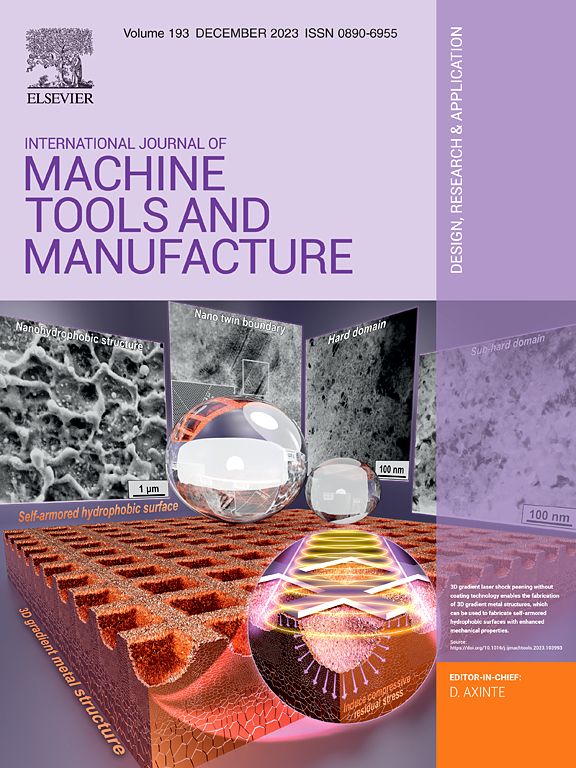
The International Journal of Machine Tools and Manufacture is dedicated to advancing scientific comprehension of the fundamental mechanics involved in processes and machines utilized in the manufacturing of engineering components. While the primary focus is on metals, the journal also explores applications in composites, ceramics, and other structural or functional materials. The coverage includes a diverse range of topics:
- Essential mechanics of processes involving material removal, accretion, and deformation, encompassing solid, semi-solid, or particulate forms.
- Significant scientific advancements in existing or new processes and machines.
- In-depth characterization of workpiece materials (structure/surfaces) through advanced techniques (e.g., SEM, EDS, TEM, EBSD, AES, Raman spectroscopy) to unveil new phenomenological aspects governing manufacturing processes.
- Tool design, utilization, and comprehensive studies of failure mechanisms.
- Innovative concepts of machine tools, fixtures, and tool holders supported by modeling and demonstrations relevant to manufacturing processes within the journal's scope.
- Novel scientific contributions exploring interactions between the machine tool, control system, software design, and processes.
- Studies elucidating specific mechanisms governing niche processes (e.g., ultra-high precision, nano/atomic level manufacturing with either mechanical or non-mechanical "tools").
- Innovative approaches, underpinned by thorough scientific analysis, addressing emerging or breakthrough processes (e.g., bio-inspired manufacturing) and/or applications (e.g., ultra-high precision optics).
 求助内容:
 应助结果提醒方式:


 京公网安备 11010802042870号


