{"title":"Methylglyoxal-Induced Modification of Hen Egg White Lysozyme: Detection of Advanced Glycation End Products by High Resolution Mass Spectrometry","authors":"Sauradipta Banerjee","doi":"10.1007/s10930-025-10299-0","DOIUrl":null,"url":null,"abstract":"<div><p>Methylglyoxal is a highly reactive α-oxoaldehyde that forms advanced glycation end products (AGEs) on reaction with proteins. Here, we have studied the effect of methylglyoxal on hen egg white lysozyme (HEWL), after incubation for different time periods (7, 14 and 21 days). Modification with methylglyoxal induced a gradual lowering of tryptophan fluorescence of the protein associated with a blue shift in the wavelength of fluorescence maximum intensity, as observed from tryptophan fluorescence spectra. Secondary structural analysis by far-UV CD spectroscopy indicated a gradual increase in α-helical content of the protein following incubation with methylglyoxal for different time periods. Subsequent analysis of methylglyoxal incubated protein samples using high-resolution ESI–MS, indicated modification of HEWL and formation of AGE adducts. HEWL incubated with methylglyoxal for 7 days indicated the formation of the AGE hydroimidazolone. Several AGE adducts, namely, hydroimidazolone, argpyrimidine, tetrahydropyrimidine, carboxymethyllysine and pyrrolidone-carboxymethyllyine were identified for HEWL incubated with methylglyoxal for 14 days. Thus, the extent of AGE formation was found to increase with increasing period of incubation with the α-oxoaldehyde as revealed by mass spectral analysis. As indicated in further studies, methylglyoxal modification was found to afford considerable resistance to the protein against stress induced aggregation. Considering the high reactivity of the α-dicarbonyl compound, the current study appears worthwhile in terms of detection of methylglyoxal-derived AGE adducts as well as understanding AGE induced protein modifications with clinical implications in treating AGE related disorders.</p></div>","PeriodicalId":793,"journal":{"name":"The Protein Journal","volume":"44 6","pages":"717 - 728"},"PeriodicalIF":1.4000,"publicationDate":"2025-10-22","publicationTypes":"Journal Article","fieldsOfStudy":null,"isOpenAccess":false,"openAccessPdf":"","citationCount":"0","resultStr":null,"platform":"Semanticscholar","paperid":null,"PeriodicalName":"The Protein Journal","FirstCategoryId":"2","ListUrlMain":"https://link.springer.com/article/10.1007/s10930-025-10299-0","RegionNum":4,"RegionCategory":"生物学","ArticlePicture":[],"TitleCN":null,"AbstractTextCN":null,"PMCID":null,"EPubDate":"","PubModel":"","JCR":"Q4","JCRName":"BIOCHEMISTRY & MOLECULAR BIOLOGY","Score":null,"Total":0}
引用次数: 0
Abstract
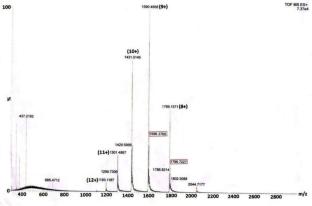
Methylglyoxal is a highly reactive α-oxoaldehyde that forms advanced glycation end products (AGEs) on reaction with proteins. Here, we have studied the effect of methylglyoxal on hen egg white lysozyme (HEWL), after incubation for different time periods (7, 14 and 21 days). Modification with methylglyoxal induced a gradual lowering of tryptophan fluorescence of the protein associated with a blue shift in the wavelength of fluorescence maximum intensity, as observed from tryptophan fluorescence spectra. Secondary structural analysis by far-UV CD spectroscopy indicated a gradual increase in α-helical content of the protein following incubation with methylglyoxal for different time periods. Subsequent analysis of methylglyoxal incubated protein samples using high-resolution ESI–MS, indicated modification of HEWL and formation of AGE adducts. HEWL incubated with methylglyoxal for 7 days indicated the formation of the AGE hydroimidazolone. Several AGE adducts, namely, hydroimidazolone, argpyrimidine, tetrahydropyrimidine, carboxymethyllysine and pyrrolidone-carboxymethyllyine were identified for HEWL incubated with methylglyoxal for 14 days. Thus, the extent of AGE formation was found to increase with increasing period of incubation with the α-oxoaldehyde as revealed by mass spectral analysis. As indicated in further studies, methylglyoxal modification was found to afford considerable resistance to the protein against stress induced aggregation. Considering the high reactivity of the α-dicarbonyl compound, the current study appears worthwhile in terms of detection of methylglyoxal-derived AGE adducts as well as understanding AGE induced protein modifications with clinical implications in treating AGE related disorders.
期刊介绍:
The Protein Journal (formerly the Journal of Protein Chemistry) publishes original research work on all aspects of proteins and peptides. These include studies concerned with covalent or three-dimensional structure determination (X-ray, NMR, cryoEM, EPR/ESR, optical methods, etc.), computational aspects of protein structure and function, protein folding and misfolding, assembly, genetics, evolution, proteomics, molecular biology, protein engineering, protein nanotechnology, protein purification and analysis and peptide synthesis, as well as the elucidation and interpretation of the molecular bases of biological activities of proteins and peptides. We accept original research papers, reviews, mini-reviews, hypotheses, opinion papers, and letters to the editor.

 求助内容:
求助内容: 应助结果提醒方式:

 京公网安备 11010802042870号


