Rana Jaber, Oana M Blaga, Marina D Dascăl, Cristian I Meghea
{"title":"E-Cigarette Use and Its Associated Factors Among Pregnant Individuals Who Currently or Formerly Smoked Cigarettes From Romania.","authors":"Rana Jaber, Oana M Blaga, Marina D Dascăl, Cristian I Meghea","doi":"10.1177/1179173X251377173","DOIUrl":null,"url":null,"abstract":"<p><p><b>Background and objective:</b> Electronic cigarettes use among pregnant individuals who currently or formerly smoked cigarettes was not previously examined in Romania. This study aimed at measuring the prevalence of ever using e-cigarette and its associated factors in a sample of pregnant individuals in Romania who currently or formerly smoked cigarettes. <b>Design:</b> Cross sectional study from formative and baseline phases of a randomized control trial. <b>Methods:</b> This study utilized data from a Randomized control trial (RCT) that was conducted between 2016 and 2019 in Romania. Data was collected via structured questionnaire at formative stage and was self-administered through the study website at baseline. The sample included 316 pregnant individuals (155 from formative phase, and 161 from baseline phase), of whom 75% were currently and 25% were formerly smoking cigarettes. <b>Results:</b> Ever using e-cigarette was reported by 122 (41.2%) of the 296 pregnant individuals who responded to this question, of whom 42 (34.4%) were currently using e-cigarettes. A total of 249 (84.4%) individuals attempted to quit smoking, of which 100 (40.2%) ever used e-cigarettes, and 35 (14.1%) used e-cigarettes at their last attempt to quit. Of the individuals who were currently using e-cigarettes, 4 (9.5%) were formerly smoking cigarettes (sole e-cigarette users) and 38 (90.5%) were currently smoking cigarettes (use both combustible and electronic cigarettes [dual users]). Low education was significantly associated with ever using e-cigarettes (OR = 5.94; 95% CI: 2.50-14.10; <i>P</i> = 0.001). <b>Conclusions:</b> High percentage of pregnant individuals used e-cigarettes and a notable percentage of them have reported current e-cigarette use. Half of the individuals who reported current e-cigarette use indicated they were using them with the intention of quitting cigarette smoking during pregnancy, though many continued to use both products (became dual users), highlighting a potential failure of cessation and ongoing nicotine exposure.</p>","PeriodicalId":43361,"journal":{"name":"Tobacco Use Insights","volume":"18 ","pages":"1179173X251377173"},"PeriodicalIF":1.8000,"publicationDate":"2025-10-15","publicationTypes":"Journal Article","fieldsOfStudy":null,"isOpenAccess":false,"openAccessPdf":"https://www.ncbi.nlm.nih.gov/pmc/articles/PMC12535625/pdf/","citationCount":"0","resultStr":null,"platform":"Semanticscholar","paperid":null,"PeriodicalName":"Tobacco Use Insights","FirstCategoryId":"1085","ListUrlMain":"https://doi.org/10.1177/1179173X251377173","RegionNum":0,"RegionCategory":null,"ArticlePicture":[],"TitleCN":null,"AbstractTextCN":null,"PMCID":null,"EPubDate":"2025/1/1 0:00:00","PubModel":"eCollection","JCR":"Q3","JCRName":"PUBLIC, ENVIRONMENTAL & OCCUPATIONAL HEALTH","Score":null,"Total":0}
引用次数: 0
Abstract
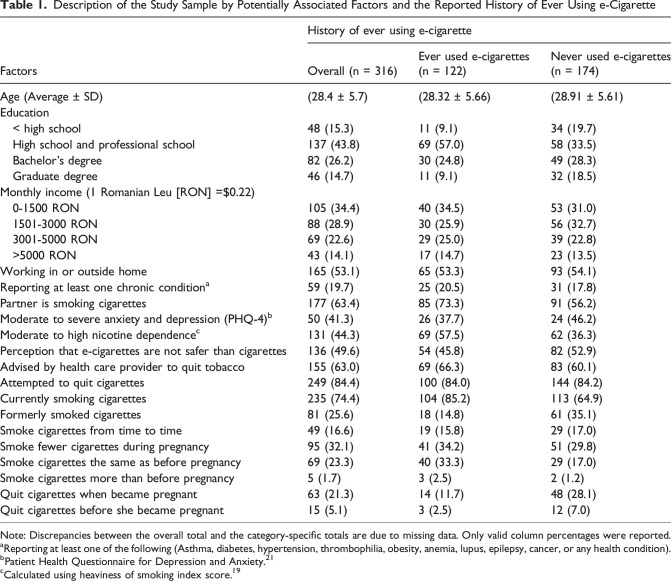
Background and objective: Electronic cigarettes use among pregnant individuals who currently or formerly smoked cigarettes was not previously examined in Romania. This study aimed at measuring the prevalence of ever using e-cigarette and its associated factors in a sample of pregnant individuals in Romania who currently or formerly smoked cigarettes. Design: Cross sectional study from formative and baseline phases of a randomized control trial. Methods: This study utilized data from a Randomized control trial (RCT) that was conducted between 2016 and 2019 in Romania. Data was collected via structured questionnaire at formative stage and was self-administered through the study website at baseline. The sample included 316 pregnant individuals (155 from formative phase, and 161 from baseline phase), of whom 75% were currently and 25% were formerly smoking cigarettes. Results: Ever using e-cigarette was reported by 122 (41.2%) of the 296 pregnant individuals who responded to this question, of whom 42 (34.4%) were currently using e-cigarettes. A total of 249 (84.4%) individuals attempted to quit smoking, of which 100 (40.2%) ever used e-cigarettes, and 35 (14.1%) used e-cigarettes at their last attempt to quit. Of the individuals who were currently using e-cigarettes, 4 (9.5%) were formerly smoking cigarettes (sole e-cigarette users) and 38 (90.5%) were currently smoking cigarettes (use both combustible and electronic cigarettes [dual users]). Low education was significantly associated with ever using e-cigarettes (OR = 5.94; 95% CI: 2.50-14.10; P = 0.001). Conclusions: High percentage of pregnant individuals used e-cigarettes and a notable percentage of them have reported current e-cigarette use. Half of the individuals who reported current e-cigarette use indicated they were using them with the intention of quitting cigarette smoking during pregnancy, though many continued to use both products (became dual users), highlighting a potential failure of cessation and ongoing nicotine exposure.



 求助内容:
求助内容: 应助结果提醒方式:

 京公网安备 11010802042870号


