
Physics-informed deep learning sharpens nano diagnostics for elusive pancreatic cancer
IF 2.5
3区 医学
Q2 ONCOLOGY
Seminars in oncology
Pub Date : 2026-02-01
Epub Date: 2025-10-22
DOI:10.1016/j.seminoncol.2025.152427
引用次数: 0
Abstract
Pancreatic disease affects over 10% of the world population, and the most dangerous is pancreatic cancer (PC). The disease is mostly of late age of onset, especially in developed countries, and is associated with poor prognosis due to late presentation. Present screening tests like imaging and biomarkers are insensitive for the high-risk group. Invasive and noninvasive imaging modalities are other diagnostic tests with variable accuracy and accompanying risks. Chemotherapy and surgery are the first lines of treatment, but only 15%–20% of patients are eligible for surgery and the rate of recurrence is very high. Emerging technologies, including physics-informed deep learning (PIDL) and artificial intelligence (AI), are improving early detection techniques by evaluating images and synthesizing data more efficiently. Nanomedicine and AI-driven radiomics are individualizing diagnoses, enhancing drug delivery, and tackling tumor microenvironment issues. Hybrid model methodologies are improving prediction precision in oncology research, while computational drug development and liquid biopsy technologies enable early diagnosis and personalized treatment. The amalgamation of AI, imaging, nanomedicine, and physics-informed models has the potential to transform PC diagnostics, enhancing early detection and patient prognoses.
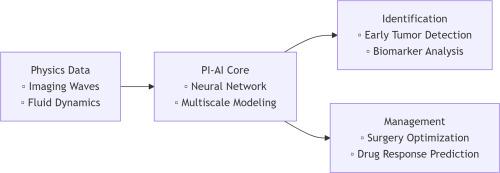
基于物理学的深度学习使难以捉摸的胰腺癌的纳米诊断更加清晰
胰腺疾病影响着超过10%的世界人口,其中最危险的是胰腺癌(PC)。该病大多发病较晚,特别是在发达国家,由于发病较晚,预后较差。目前的筛查测试,如成像和生物标志物对高危人群不敏感。侵入性和非侵入性成像方式是另一种诊断测试,具有不同的准确性和伴随的风险。化疗和手术是治疗的第一线,但只有15%-20%的患者符合手术条件,复发率很高。包括基于物理的深度学习(PIDL)和人工智能(AI)在内的新兴技术正在通过更有效地评估图像和合成数据来改进早期检测技术。纳米医学和人工智能驱动的放射组学正在个性化诊断、增强药物输送和解决肿瘤微环境问题。混合模型方法正在提高肿瘤研究的预测精度,而计算药物开发和液体活检技术使早期诊断和个性化治疗成为可能。人工智能、成像、纳米医学和物理信息模型的融合有可能改变PC诊断,增强早期检测和患者预后。
本文章由计算机程序翻译,如有差异,请以英文原文为准。
求助全文
约1分钟内获得全文
求助全文
来源期刊
Seminars in oncology
医学-肿瘤学
CiteScore
6.60
自引率
0.00%
发文量
58
审稿时长
104 days
期刊介绍:
Seminars in Oncology brings you current, authoritative, and practical reviews of developments in the etiology, diagnosis and management of cancer. Each issue examines topics of clinical importance, with an emphasis on providing both the basic knowledge needed to better understand a topic as well as evidence-based opinions from leaders in the field. Seminars in Oncology also seeks to be a venue for sharing a diversity of opinions including those that might be considered "outside the box". We welcome a healthy and respectful exchange of opinions and urge you to approach us with your insights as well as suggestions of topics that you deem worthy of coverage. By helping the reader understand the basic biology and the therapy of cancer as they learn the nuances from experts, all in a journal that encourages the exchange of ideas we aim to help move the treatment of cancer forward.
 求助内容:
求助内容: 应助结果提醒方式:

 京公网安备 11010802042870号


