A Detailed Characterization of Asthma Manifestations and Their Associations with Dietary Intakes in a Singapore Cohort of Young Chinese Adults: A Cross-Sectional Study.
Jun Jie Lim, Zong Xun Huang, Evelyn Xiu Ling Loo, Mei Hui Liu, Fook Tim Chew
{"title":"A Detailed Characterization of Asthma Manifestations and Their Associations with Dietary Intakes in a Singapore Cohort of Young Chinese Adults: A Cross-Sectional Study.","authors":"Jun Jie Lim, Zong Xun Huang, Evelyn Xiu Ling Loo, Mei Hui Liu, Fook Tim Chew","doi":"10.2147/JAA.S538254","DOIUrl":null,"url":null,"abstract":"<p><strong>Purpose: </strong>Asthma is a heterogeneous disease with phenotypic variations potentially influenced by dietary factors. This cross-sectional study aimed to estimate the prevalence of current allergic asthma (AA), characterize its phenotypic variants, and examine dietary associations with asthma manifestations among young Chinese adults in Singapore.</p><p><strong>Patients and methods: </strong>We assessed 10,544 young Chinese participants (mean age 22.3 ± 5.5 years; male: female = 0.74) using a standardized, investigator-administered questionnaire adapted from the International Study of Asthma and Allergies in Childhood. Current AA was defined as a history of doctor diagnosis with symptoms in the past 12 months and having allergic sensitization to common house dust mites. Dietary intake across 16 food groups was assessed using a semi-quantitative food frequency questionnaire. Multivariable logistic regression, adjusted for sociodemographic and lifestyle factors, examined dietary associations with AA outcomes.</p><p><strong>Results: </strong>The prevalence of current AA was 5.24%. Among those with current AA, 67.0% (370/552) had mild, 21.7% (120/552) moderate, and 11.2% (62/552) severe asthma. Asthma was well-controlled in 60.7% (319/552), partly controlled in 39.3% (217/552), and poorly controlled in 2.9% (16/552). Common phenotypes included cough-variant (57.6%), wheezy variant (55.1%), and exercise-induced asthma (31.5%), with overlapping symptoms. Frequent intake (most or all days) of pulses (Adjusted odds ratio [AOR]: 0.65; 95% confidence intervals [CI]: 0.47-0.89; p < 0.001), probiotic drinks (AOR: 0.69; 95% CI: 0.50-0.94; p < 0.001), fruits (AOR: 0.47; 95% CI: 0.31-0.71; p = 0.001), and vegetables (AOR: 0.58; 95% CI: 0.35-0.99; p = 0.003) was associated with protective odds of current AA. Pulses were also associated with reduced odds of exacerbated and wheezy AA, while occasional (once or twice per week) intake of probiotic drinks was associated with reduced odds of cough-variant and wheezy AA.</p><p><strong>Conclusion: </strong>While certain plant-based foods and probiotic drinks were associated with reduced odds of AA and its phenotypes, these findings should be interpreted with caution given the cross-sectional design. Longitudinal or interventional studies are needed to clarify causality and underlying mechanisms.</p>","PeriodicalId":15079,"journal":{"name":"Journal of Asthma and Allergy","volume":"18 ","pages":"1399-1412"},"PeriodicalIF":3.0000,"publicationDate":"2025-10-14","publicationTypes":"Journal Article","fieldsOfStudy":null,"isOpenAccess":false,"openAccessPdf":"https://www.ncbi.nlm.nih.gov/pmc/articles/PMC12535299/pdf/","citationCount":"0","resultStr":null,"platform":"Semanticscholar","paperid":null,"PeriodicalName":"Journal of Asthma and Allergy","FirstCategoryId":"3","ListUrlMain":"https://doi.org/10.2147/JAA.S538254","RegionNum":3,"RegionCategory":"医学","ArticlePicture":[],"TitleCN":null,"AbstractTextCN":null,"PMCID":null,"EPubDate":"2025/1/1 0:00:00","PubModel":"eCollection","JCR":"Q2","JCRName":"ALLERGY","Score":null,"Total":0}
引用次数: 0
Abstract
Purpose: Asthma is a heterogeneous disease with phenotypic variations potentially influenced by dietary factors. This cross-sectional study aimed to estimate the prevalence of current allergic asthma (AA), characterize its phenotypic variants, and examine dietary associations with asthma manifestations among young Chinese adults in Singapore.
Patients and methods: We assessed 10,544 young Chinese participants (mean age 22.3 ± 5.5 years; male: female = 0.74) using a standardized, investigator-administered questionnaire adapted from the International Study of Asthma and Allergies in Childhood. Current AA was defined as a history of doctor diagnosis with symptoms in the past 12 months and having allergic sensitization to common house dust mites. Dietary intake across 16 food groups was assessed using a semi-quantitative food frequency questionnaire. Multivariable logistic regression, adjusted for sociodemographic and lifestyle factors, examined dietary associations with AA outcomes.
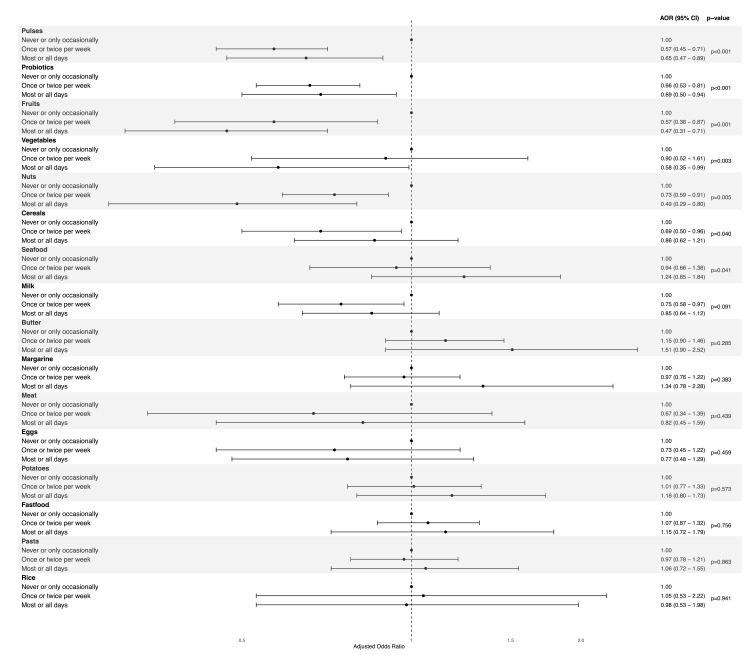
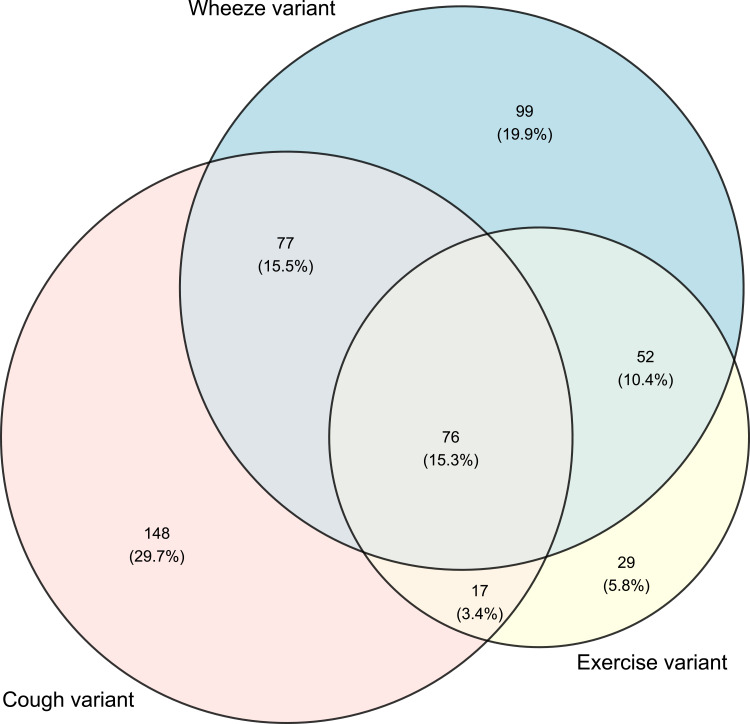
Results: The prevalence of current AA was 5.24%. Among those with current AA, 67.0% (370/552) had mild, 21.7% (120/552) moderate, and 11.2% (62/552) severe asthma. Asthma was well-controlled in 60.7% (319/552), partly controlled in 39.3% (217/552), and poorly controlled in 2.9% (16/552). Common phenotypes included cough-variant (57.6%), wheezy variant (55.1%), and exercise-induced asthma (31.5%), with overlapping symptoms. Frequent intake (most or all days) of pulses (Adjusted odds ratio [AOR]: 0.65; 95% confidence intervals [CI]: 0.47-0.89; p < 0.001), probiotic drinks (AOR: 0.69; 95% CI: 0.50-0.94; p < 0.001), fruits (AOR: 0.47; 95% CI: 0.31-0.71; p = 0.001), and vegetables (AOR: 0.58; 95% CI: 0.35-0.99; p = 0.003) was associated with protective odds of current AA. Pulses were also associated with reduced odds of exacerbated and wheezy AA, while occasional (once or twice per week) intake of probiotic drinks was associated with reduced odds of cough-variant and wheezy AA.
Conclusion: While certain plant-based foods and probiotic drinks were associated with reduced odds of AA and its phenotypes, these findings should be interpreted with caution given the cross-sectional design. Longitudinal or interventional studies are needed to clarify causality and underlying mechanisms.
期刊介绍:
An international, peer-reviewed journal publishing original research, reports, editorials and commentaries on the following topics: Asthma; Pulmonary physiology; Asthma related clinical health; Clinical immunology and the immunological basis of disease; Pharmacological interventions and new therapies.
Although the main focus of the journal will be to publish research and clinical results in humans, preclinical, animal and in vitro studies will be published where they shed light on disease processes and potential new therapies.


 求助内容:
求助内容: 应助结果提醒方式:

 京公网安备 11010802042870号


