Bogdan Hirtie, Ana-Maria Stanoiu, Kristine Guran, Norberth-Istvan Varga, Claudia Raluca Balasa Virzob, Delia Hutanu, Adrian Cote, Rodica Anamaria Negrean, Delia Ioana Horhat, Cristian Ion Mot
{"title":"Low Vitamin D and High Psychological Distress: Are They Associated with Poor Differentiation in Head and Neck Cancer?","authors":"Bogdan Hirtie, Ana-Maria Stanoiu, Kristine Guran, Norberth-Istvan Varga, Claudia Raluca Balasa Virzob, Delia Hutanu, Adrian Cote, Rodica Anamaria Negrean, Delia Ioana Horhat, Cristian Ion Mot","doi":"10.3390/clinpract15090164","DOIUrl":null,"url":null,"abstract":"<p><p><b>Background and Objectives:</b> Vitamin D deficiency and psychological distress have been linked to cancer biology, but their relevance to tumor differentiation in head-and-neck squamous cell carcinoma (HNSCC) is uncertain. <b>Materials and Methods:</b> In this cross-sectional study at the Department of Otolaryngology, County Hospital of Timișoara, Romania, we enrolled newly diagnosed HNC patients from October 2023 to December 2024, analyzing 199 SCC patients after exclusions. Vitamin D status was assessed using serum 25-OH-vitamin D levels, and distress was measured with the validated Romanian version of the Hospital Anxiety and Depression Scale (HADS). Tumor aggressiveness was defined by histological grade (G3 vs. G1-G2). Univariate, multivariate, and subgroup analyses were conducted, adjusting for confounders like smoking. <b>Results:</b> Vitamin D deficiency (<20 ng/mL) was prevalent (80.40%), with median 25-OH-vitamin D levels of 15.1 ng/mL. Univariate analysis revealed a modest association between vitamin D deficiency and poorly differentiated tumors (G3 vs. G1-G2; OR = 1.79, <i>p</i> = 0.055) and between clinically significant anxiety (HADS-A ≥ 8) and G3 tumors (OR = 1.71, <i>p</i> = 0.059). A weak negative correlation was observed between 25-OH-vitamin D levels and HADS-A scores (rho = -0.17, <i>p</i> = 0.052). In multivariate analysis adjusted for age, smoking, and tumor location, these associations weakened (vitamin D deficiency: OR = 1.55, <i>p</i> = 0.082; HADS-A ≥8: OR = 1.56, <i>p</i> = 0.113). Subgroup analysis suggested a trend toward higher odds of G3 tumors in patients with both vitamin D deficiency and high anxiety (OR = 1.72, <i>p</i> = 0.075). <b>Conclusions</b>: Univariate analyses indicated potential links between vitamin D deficiency, psychological distress, and tumor aggressiveness in HNSCC, but these did not reach statistical significance after adjustment for confounders. The observed trends, particularly in subgroups with combined deficiency and distress, suggest a possible interplay worth exploring further. To conclude, neither vitamin-D deficiency nor clinically significant distress independently predicted poor histological differentiation after adjustment; observed trends, including a possible distress-vitamin-D interaction, are hypothesis-generating and warrant testing in larger, longitudinal cohorts.</p>","PeriodicalId":45306,"journal":{"name":"Clinics and Practice","volume":"15 9","pages":""},"PeriodicalIF":2.2000,"publicationDate":"2025-09-12","publicationTypes":"Journal Article","fieldsOfStudy":null,"isOpenAccess":false,"openAccessPdf":"https://www.ncbi.nlm.nih.gov/pmc/articles/PMC12468392/pdf/","citationCount":"0","resultStr":null,"platform":"Semanticscholar","paperid":null,"PeriodicalName":"Clinics and Practice","FirstCategoryId":"1085","ListUrlMain":"https://doi.org/10.3390/clinpract15090164","RegionNum":0,"RegionCategory":null,"ArticlePicture":[],"TitleCN":null,"AbstractTextCN":null,"PMCID":null,"EPubDate":"","PubModel":"","JCR":"Q2","JCRName":"MEDICINE, GENERAL & INTERNAL","Score":null,"Total":0}
引用次数: 0
Abstract
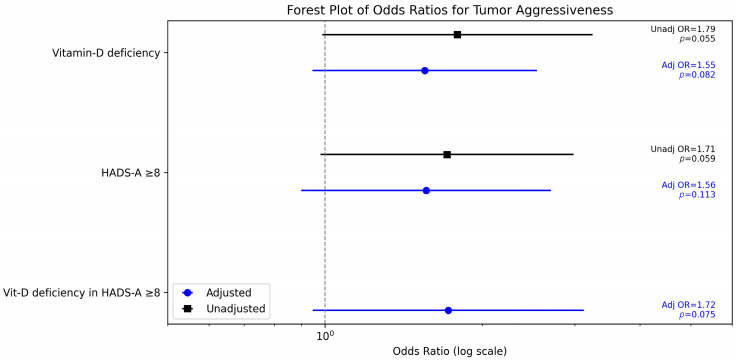
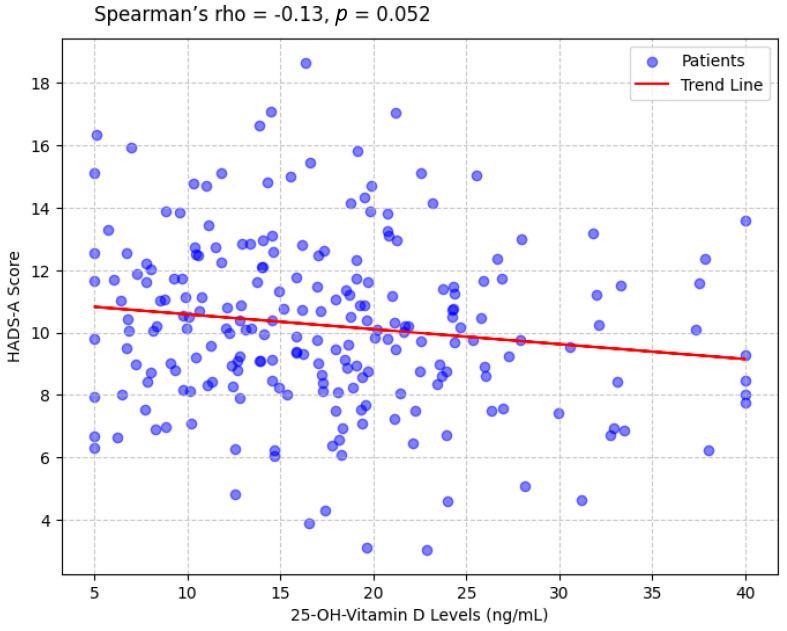
Background and Objectives: Vitamin D deficiency and psychological distress have been linked to cancer biology, but their relevance to tumor differentiation in head-and-neck squamous cell carcinoma (HNSCC) is uncertain. Materials and Methods: In this cross-sectional study at the Department of Otolaryngology, County Hospital of Timișoara, Romania, we enrolled newly diagnosed HNC patients from October 2023 to December 2024, analyzing 199 SCC patients after exclusions. Vitamin D status was assessed using serum 25-OH-vitamin D levels, and distress was measured with the validated Romanian version of the Hospital Anxiety and Depression Scale (HADS). Tumor aggressiveness was defined by histological grade (G3 vs. G1-G2). Univariate, multivariate, and subgroup analyses were conducted, adjusting for confounders like smoking. Results: Vitamin D deficiency (<20 ng/mL) was prevalent (80.40%), with median 25-OH-vitamin D levels of 15.1 ng/mL. Univariate analysis revealed a modest association between vitamin D deficiency and poorly differentiated tumors (G3 vs. G1-G2; OR = 1.79, p = 0.055) and between clinically significant anxiety (HADS-A ≥ 8) and G3 tumors (OR = 1.71, p = 0.059). A weak negative correlation was observed between 25-OH-vitamin D levels and HADS-A scores (rho = -0.17, p = 0.052). In multivariate analysis adjusted for age, smoking, and tumor location, these associations weakened (vitamin D deficiency: OR = 1.55, p = 0.082; HADS-A ≥8: OR = 1.56, p = 0.113). Subgroup analysis suggested a trend toward higher odds of G3 tumors in patients with both vitamin D deficiency and high anxiety (OR = 1.72, p = 0.075). Conclusions: Univariate analyses indicated potential links between vitamin D deficiency, psychological distress, and tumor aggressiveness in HNSCC, but these did not reach statistical significance after adjustment for confounders. The observed trends, particularly in subgroups with combined deficiency and distress, suggest a possible interplay worth exploring further. To conclude, neither vitamin-D deficiency nor clinically significant distress independently predicted poor histological differentiation after adjustment; observed trends, including a possible distress-vitamin-D interaction, are hypothesis-generating and warrant testing in larger, longitudinal cohorts.


 求助内容:
求助内容: 应助结果提醒方式:

 京公网安备 11010802042870号

