Yingze Liu, , , Yifu Chen*, , , Jie Zhang, , and , Xinhua Wan*,
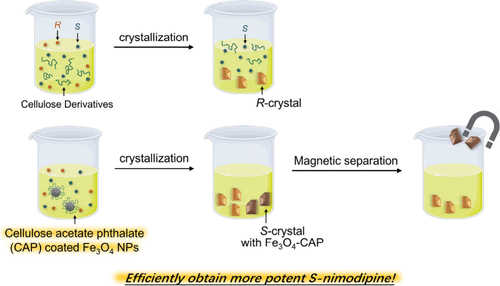
{"title":"Magnetic Sorting of Chiral Pharmaceuticals Using Fe3O4–Cellulose Acetate Phthalate Nanosplitters","authors":"Yingze Liu, , , Yifu Chen*, , , Jie Zhang, , and , Xinhua Wan*, ","doi":"10.1021/jacs.5c10439","DOIUrl":null,"url":null,"abstract":"<p >Natural polymers have been used as stereoselective crystallization inhibitors benefiting from their intrinsic hierarchical chirality. However, the chirality of their constituent unit is intrinsically immutable due to the natural biosynthetic origin of biopolymers, fundamentally limiting their versatility, as they cannot be synthetically inverted to target the opposite enantiomer. Herein, we designed a magnetic nanosplitter by grafting cellulose acetate phthalate onto Fe<sub>3</sub>O<sub>4</sub> nanoparticles to selectively interact with the crystals of one enantiomer, enabling them to form magnetized crystals that can be efficiently separated from their racemic conglomerate with an external magnetic field. This approach enabled the resolution of racemic nimodipine, simultaneously yielding considerable quantities of magnetic <i>S</i>-crystals and nonmagnetic <i>R</i>-crystals. It should be mentioned that using pristine natural polymer derivatives can only obtain crystals of one enantiomer, the less pharmacologically active <i>R</i>-crystals. Further structural investigation revealed that the chain length of the polymer and the size of Fe<sub>3</sub>O<sub>4</sub> nanoparticles significantly influence the resolution of the nanosplitters. When containing cellulose acetate phthalate with a molecular weight above 20 kDa and Fe<sub>3</sub>O<sub>4</sub> cores sized between 5 and 14 nm, the optimal performance has been achieved, producing <i>S</i>- and <i>R</i>-enantiomers with 82 <i>ee</i>% and 92 <i>ee</i>%, respectively, and a combined yield of 40%. This work pioneers a magnetically driven separation strategy that can be seamlessly integrated into automated chiral separation platforms.</p>","PeriodicalId":49,"journal":{"name":"Journal of the American Chemical Society","volume":"147 41","pages":"37265–37271"},"PeriodicalIF":16.6000,"publicationDate":"2025-09-17","publicationTypes":"Journal Article","fieldsOfStudy":null,"isOpenAccess":false,"openAccessPdf":"","citationCount":"0","resultStr":null,"platform":"Semanticscholar","paperid":null,"PeriodicalName":"Journal of the American Chemical Society","FirstCategoryId":"92","ListUrlMain":"https://pubs.acs.org/doi/10.1021/jacs.5c10439","RegionNum":1,"RegionCategory":"化学","ArticlePicture":[],"TitleCN":null,"AbstractTextCN":null,"PMCID":null,"EPubDate":"","PubModel":"","JCR":"Q1","JCRName":"CHEMISTRY, MULTIDISCIPLINARY","Score":null,"Total":0}
引用次数: 0
Abstract
Natural polymers have been used as stereoselective crystallization inhibitors benefiting from their intrinsic hierarchical chirality. However, the chirality of their constituent unit is intrinsically immutable due to the natural biosynthetic origin of biopolymers, fundamentally limiting their versatility, as they cannot be synthetically inverted to target the opposite enantiomer. Herein, we designed a magnetic nanosplitter by grafting cellulose acetate phthalate onto Fe3O4 nanoparticles to selectively interact with the crystals of one enantiomer, enabling them to form magnetized crystals that can be efficiently separated from their racemic conglomerate with an external magnetic field. This approach enabled the resolution of racemic nimodipine, simultaneously yielding considerable quantities of magnetic S-crystals and nonmagnetic R-crystals. It should be mentioned that using pristine natural polymer derivatives can only obtain crystals of one enantiomer, the less pharmacologically active R-crystals. Further structural investigation revealed that the chain length of the polymer and the size of Fe3O4 nanoparticles significantly influence the resolution of the nanosplitters. When containing cellulose acetate phthalate with a molecular weight above 20 kDa and Fe3O4 cores sized between 5 and 14 nm, the optimal performance has been achieved, producing S- and R-enantiomers with 82 ee% and 92 ee%, respectively, and a combined yield of 40%. This work pioneers a magnetically driven separation strategy that can be seamlessly integrated into automated chiral separation platforms.
期刊介绍:
The flagship journal of the American Chemical Society, known as the Journal of the American Chemical Society (JACS), has been a prestigious publication since its establishment in 1879. It holds a preeminent position in the field of chemistry and related interdisciplinary sciences. JACS is committed to disseminating cutting-edge research papers, covering a wide range of topics, and encompasses approximately 19,000 pages of Articles, Communications, and Perspectives annually. With a weekly publication frequency, JACS plays a vital role in advancing the field of chemistry by providing essential research.


 求助内容:
求助内容: 应助结果提醒方式:

 京公网安备 11010802042870号


