
Future Digital Identity Management With Quantum Secure Blockchain
IF 50.6
1区 计算机科学
Q1 COMPUTER SCIENCE, INFORMATION SYSTEMS
IEEE Communications Surveys and Tutorials
Pub Date : 2026-01-01
Epub Date: 2025-09-11
DOI:10.1109/COMST.2025.3608794
引用次数: 0
Abstract
Quantum computing poses a significant threat to the cryptographic foundations of traditional blockchain-based identity management systems and could compromise the security and privacy of digital identities. This survey critically evaluates the emerging landscape of quantum-secure blockchain solutions for digital identity management. We analyze the technical underpinnings, strengths, weaknesses, and potential applications of post-quantum, hybrid-quantum, and fully quantum blockchain approaches. Post-quantum blockchains leveraging quantum-resistant cryptographic algorithms such as lattice-based (e.g., CRYSTALS-Dilithium), hash-based (e.g., SPHINCS+), code-based (e.g., McEliece), and multivariate schemes offer near-term feasibility by integrating into existing infrastructures but face performance trade-offs and potential long-term risks. Hybrid quantum blockchains combining classical blockchain mechanisms with quantum technologies enable enhanced security and gradual transitions but require complex integration efforts and specialized infrastructure. Fully quantum blockchains utilizing quantum entanglement and quantum key distribution (QKD) promise unmatched theoretical security but remain constrained by the immaturity of quantum hardware and algorithms. To provide actionable insights, this paper introduces the Quantum Blockchain Digital Identity Framework (QBDIF) and examines practical implementations such as the Quantum Resistant Ledger (QRL), highlighting critical trade-offs between security, scalability, and practicality in quantum-secure identity management. Our survey emphasizes the need for future research in scalable and efficient quantum-resistant cryptographic algorithms, hybrid consensus mechanisms, and innovative applications of quantum machine learning for blockchain-based identity systems.基于量子安全区块链的未来数字身份管理
量子计算对传统的基于区块链的身份管理系统的加密基础构成重大威胁,并可能危及数字身份的安全性和隐私性。这项调查批判性地评估了用于数字身份管理的量子安全区块链解决方案的新兴前景。我们分析了后量子、混合量子和全量子区块链方法的技术基础、优势、劣势和潜在应用。后量子区块链利用抗量子加密算法,如基于格子(如CRYSTALS-Dilithium)、基于哈希(如SPHINCS+)、基于代码(如McEliece)和多元方案,通过集成到现有基础设施中提供短期可行性,但面临性能权衡和潜在的长期风险。混合量子区块链将经典区块链机制与量子技术相结合,可以增强安全性和逐步过渡,但需要复杂的集成工作和专门的基础设施。利用量子纠缠和量子密钥分发(QKD)的全量子区块链承诺无与伦比的理论安全性,但仍然受到量子硬件和算法不成熟的限制。为了提供可操作的见解,本文介绍了量子区块链数字身份框架(QBDIF),并研究了诸如量子抗账本(QRL)等实际实现,强调了量子安全身份管理中安全性、可扩展性和实用性之间的关键权衡。我们的调查强调了未来研究可扩展和高效的抗量子加密算法、混合共识机制以及基于区块链身份系统的量子机器学习的创新应用的必要性。
本文章由计算机程序翻译,如有差异,请以英文原文为准。
求助全文
约1分钟内获得全文
求助全文
来源期刊
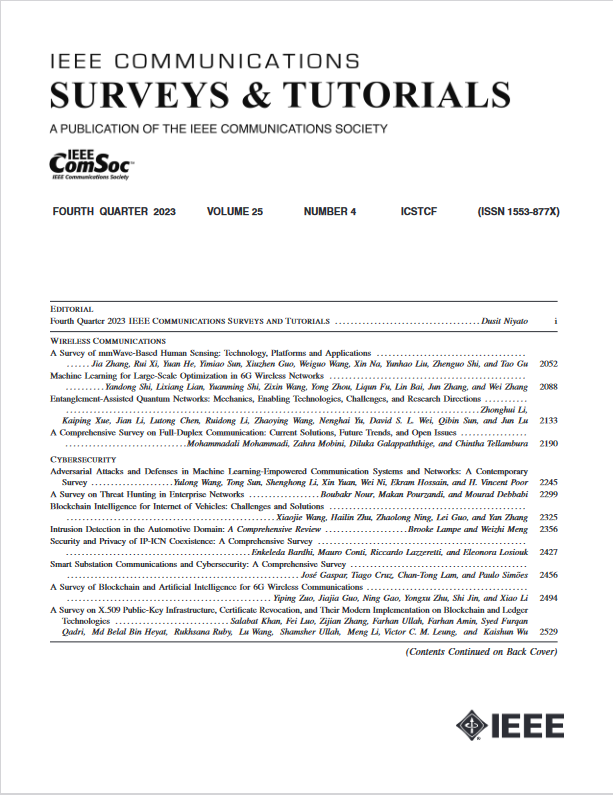
IEEE Communications Surveys and Tutorials
COMPUTER SCIENCE, INFORMATION SYSTEMS-TELECOMMUNICATIONS
CiteScore
80.20
自引率
2.50%
发文量
84
审稿时长
6 months
期刊介绍:
IEEE Communications Surveys & Tutorials is an online journal published by the IEEE Communications Society for tutorials and surveys covering all aspects of the communications field. Telecommunications technology is progressing at a rapid pace, and the IEEE Communications Society is committed to providing researchers and other professionals the information and tools to stay abreast. IEEE Communications Surveys and Tutorials focuses on integrating and adding understanding to the existing literature on communications, putting results in context. Whether searching for in-depth information about a familiar area or an introduction into a new area, IEEE Communications Surveys & Tutorials aims to be the premier source of peer-reviewed, comprehensive tutorials and surveys, and pointers to further sources. IEEE Communications Surveys & Tutorials publishes only articles exclusively written for IEEE Communications Surveys & Tutorials and go through a rigorous review process before their publication in the quarterly issues.
A tutorial article in the IEEE Communications Surveys & Tutorials should be designed to help the reader to become familiar with and learn something specific about a chosen topic. In contrast, the term survey, as applied here, is defined to mean a survey of the literature. A survey article in IEEE Communications Surveys & Tutorials should provide a comprehensive review of developments in a selected area, covering its development from its inception to its current state and beyond, and illustrating its development through liberal citations from the literature. Both tutorials and surveys should be tutorial in nature and should be written in a style comprehensible to readers outside the specialty of the article.
 求助内容:
 应助结果提醒方式:


 京公网安备 11010802042870号


