Youmei Chen, Mengshi Dong, Jie Sun, Zhanao Meng, Yiqing Yang, Abudushalamu Muhetaier, Chao Li, Jie Qin
{"title":"Leveraging GPT-4o for Automated Extraction and Categorization of CAD-RADS Features From Free-Text Coronary CT Angiography Reports: Diagnostic Study.","authors":"Youmei Chen, Mengshi Dong, Jie Sun, Zhanao Meng, Yiqing Yang, Abudushalamu Muhetaier, Chao Li, Jie Qin","doi":"10.2196/70967","DOIUrl":null,"url":null,"abstract":"<p><strong>Background: </strong>Despite the Coronary Artery Reporting and Data System (CAD-RADS) providing a standardized approach, radiologists continue to favor free-text reports. This preference creates significant challenges for data extraction and analysis in longitudinal studies, potentially limiting large-scale research and quality assessment initiatives.</p><p><strong>Objective: </strong>To evaluate the ability of the generative pre-trained transformer (GPT)-4o model to convert real-world coronary computed tomography angiography (CCTA) free-text reports into structured data and automatically identify CAD-RADS categories and P categories.</p><p><strong>Methods: </strong>This retrospective study analyzed CCTA reports from January 2024 and July 2024. A subset of 25 reports was used for prompt engineering to instruct the large language models (LLMs) in extracting CAD-RADS categories, P categories, and the presence of myocardial bridges and noncalcified plaques. Reports were processed using the GPT-4o API (application programming interface) and custom Python scripts. The ground truth was established by radiologists based on the CAD-RADS 2.0 guidelines. Model performance was assessed using accuracy, sensitivity, specificity, and F1-score. Intrarater reliability was assessed using Cohen κ coefficient.</p><p><strong>Results: </strong>Among 999 patients (median age 66 y, range 58-74; 650 males), CAD-RADS categorization showed accuracy of 0.98-1.00 (95% CI 0.9730-1.0000), sensitivity of 0.95-1.00 (95% CI 0.9191-1.0000), specificity of 0.98-1.00 (95% CI 0.9669-1.0000), and F1-score of 0.96-1.00 (95% CI 0.9253-1.0000). P categories demonstrated accuracy of 0.97-1.00 (95% CI 0.9569-0.9990), sensitivity from 0.90 to 1.00 (95% CI 0.8085-1.0000), specificity from 0.97 to 1.00 (95% CI 0.9533-1.0000), and F1-score from 0.91 to 0.99 (95% CI 0.8377-0.9967). Myocardial bridge detection achieved an accuracy of 0.98 (95% CI 0.9680-0.9870), and noncalcified coronary plaques detection showed an accuracy of 0.98 (95% CI 0.9680-0.9870). Cohen κ values for all classifications exceeded 0.98.</p><p><strong>Conclusions: </strong>The GPT-4o model efficiently and accurately converts CCTA free-text reports into structured data, excelling in CAD-RADS classification, plaque burden assessment, and detection of myocardial bridges and calcified plaques.</p>","PeriodicalId":56334,"journal":{"name":"JMIR Medical Informatics","volume":"13 ","pages":"e70967"},"PeriodicalIF":3.8000,"publicationDate":"2025-09-10","publicationTypes":"Journal Article","fieldsOfStudy":null,"isOpenAccess":false,"openAccessPdf":"https://www.ncbi.nlm.nih.gov/pmc/articles/PMC12422720/pdf/","citationCount":"0","resultStr":null,"platform":"Semanticscholar","paperid":null,"PeriodicalName":"JMIR Medical Informatics","FirstCategoryId":"3","ListUrlMain":"https://doi.org/10.2196/70967","RegionNum":3,"RegionCategory":"医学","ArticlePicture":[],"TitleCN":null,"AbstractTextCN":null,"PMCID":null,"EPubDate":"","PubModel":"","JCR":"Q2","JCRName":"MEDICAL INFORMATICS","Score":null,"Total":0}
引用次数: 0
Abstract
Background: Despite the Coronary Artery Reporting and Data System (CAD-RADS) providing a standardized approach, radiologists continue to favor free-text reports. This preference creates significant challenges for data extraction and analysis in longitudinal studies, potentially limiting large-scale research and quality assessment initiatives.
Objective: To evaluate the ability of the generative pre-trained transformer (GPT)-4o model to convert real-world coronary computed tomography angiography (CCTA) free-text reports into structured data and automatically identify CAD-RADS categories and P categories.
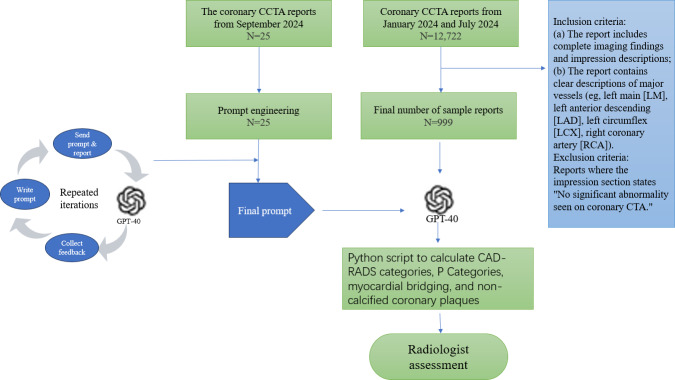
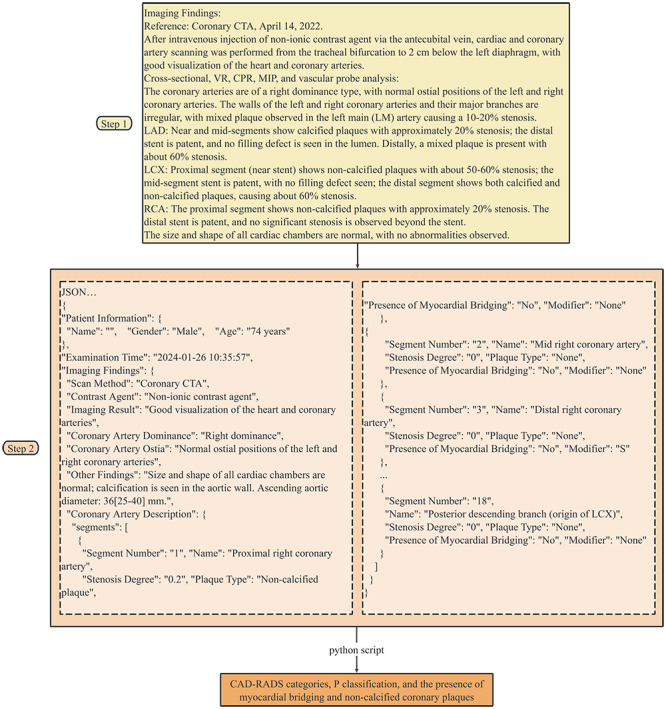
Methods: This retrospective study analyzed CCTA reports from January 2024 and July 2024. A subset of 25 reports was used for prompt engineering to instruct the large language models (LLMs) in extracting CAD-RADS categories, P categories, and the presence of myocardial bridges and noncalcified plaques. Reports were processed using the GPT-4o API (application programming interface) and custom Python scripts. The ground truth was established by radiologists based on the CAD-RADS 2.0 guidelines. Model performance was assessed using accuracy, sensitivity, specificity, and F1-score. Intrarater reliability was assessed using Cohen κ coefficient.
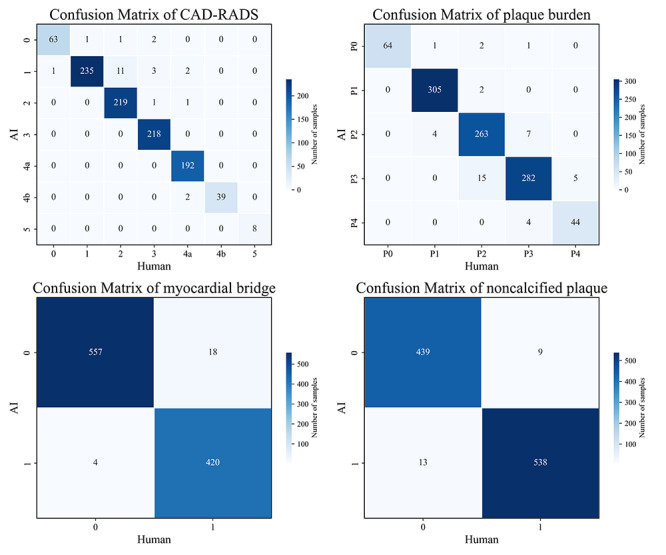
Results: Among 999 patients (median age 66 y, range 58-74; 650 males), CAD-RADS categorization showed accuracy of 0.98-1.00 (95% CI 0.9730-1.0000), sensitivity of 0.95-1.00 (95% CI 0.9191-1.0000), specificity of 0.98-1.00 (95% CI 0.9669-1.0000), and F1-score of 0.96-1.00 (95% CI 0.9253-1.0000). P categories demonstrated accuracy of 0.97-1.00 (95% CI 0.9569-0.9990), sensitivity from 0.90 to 1.00 (95% CI 0.8085-1.0000), specificity from 0.97 to 1.00 (95% CI 0.9533-1.0000), and F1-score from 0.91 to 0.99 (95% CI 0.8377-0.9967). Myocardial bridge detection achieved an accuracy of 0.98 (95% CI 0.9680-0.9870), and noncalcified coronary plaques detection showed an accuracy of 0.98 (95% CI 0.9680-0.9870). Cohen κ values for all classifications exceeded 0.98.
Conclusions: The GPT-4o model efficiently and accurately converts CCTA free-text reports into structured data, excelling in CAD-RADS classification, plaque burden assessment, and detection of myocardial bridges and calcified plaques.
期刊介绍:
JMIR Medical Informatics (JMI, ISSN 2291-9694) is a top-rated, tier A journal which focuses on clinical informatics, big data in health and health care, decision support for health professionals, electronic health records, ehealth infrastructures and implementation. It has a focus on applied, translational research, with a broad readership including clinicians, CIOs, engineers, industry and health informatics professionals.
Published by JMIR Publications, publisher of the Journal of Medical Internet Research (JMIR), the leading eHealth/mHealth journal (Impact Factor 2016: 5.175), JMIR Med Inform has a slightly different scope (emphasizing more on applications for clinicians and health professionals rather than consumers/citizens, which is the focus of JMIR), publishes even faster, and also allows papers which are more technical or more formative than what would be published in the Journal of Medical Internet Research.


 求助内容:
求助内容: 应助结果提醒方式:

 京公网安备 11010802042870号

