{"title":"Peptide-Programmable DNAzyme Converter for Artificial Autocatalytic Gene Regulation","authors":"Qingqing Zhang, , , Jian Hao, , , Yuqiu He, , , Benrui Weng, , , Shanshan Yu, , , Chunsen Li*, , and , Fuan Wang*, ","doi":"10.1021/jacs.5c11409","DOIUrl":null,"url":null,"abstract":"<p >The in-depth integration of gene regulation with protein modulation can enhance cellular information processing, yet it is significantly constrained by ineffective and complex protein-to-gene transduction strategies. Herein, we developed a simple protease-guided autocatalytic gene silencing platform named iPAD (intelligent peptide-programmed deoxyribonuclease) that converts the protease recognition events into versatile DNA readout signals by rationally designing a native protease-responsive cationic peptide (PP) to efficiently modulate the DNAzyme (Dz) activity. Without requiring additional chemical modifications, the multifunctional PP regulator consists simply of one cell-specific targeting peptide segment and two cationic peptide segments isolated by one protease-specific peptide substrate. The catalytic activity of Dz can be potently disrupted via the cooperatively stabilized electrostatic interactions between cationic PP and the anionic Dz. Subsequently, the Dz activity is efficiently restored via the protease-specific cleavage of the PP, which disrupts the cooperative stabilization between PP and Dz, thus achieving robust and accurate monitoring of protease activity. Molecular dynamic simulations theoretically validate that the on-demand regulation of Dz activity was indeed acquired from the programmed oligomerization of oligo-peptides. As a universal protease sensing platform, this method was successfully applied to probe Caspase-3 and thrombin, facilitating the early evaluation of tumor therapeutic efficacy. Moreover, the endogenous Caspase-3-activated Dz facilitates the construction of an autocatalytic gene regulation platform that self-adaptively upregulates the expression of apoptotic proteases, accelerating tumor cell apoptosis. This simple yet intelligent iPAD system provides a versatile toolbox for high-performance biosensing and bioengineering applications, paving the way for new strategies in smart theragnostic research.</p>","PeriodicalId":49,"journal":{"name":"Journal of the American Chemical Society","volume":"147 38","pages":"34944–34958"},"PeriodicalIF":16.6000,"publicationDate":"2025-09-10","publicationTypes":"Journal Article","fieldsOfStudy":null,"isOpenAccess":false,"openAccessPdf":"","citationCount":"0","resultStr":null,"platform":"Semanticscholar","paperid":null,"PeriodicalName":"Journal of the American Chemical Society","FirstCategoryId":"92","ListUrlMain":"https://pubs.acs.org/doi/10.1021/jacs.5c11409","RegionNum":1,"RegionCategory":"化学","ArticlePicture":[],"TitleCN":null,"AbstractTextCN":null,"PMCID":null,"EPubDate":"","PubModel":"","JCR":"Q1","JCRName":"CHEMISTRY, MULTIDISCIPLINARY","Score":null,"Total":0}
引用次数: 0
Abstract
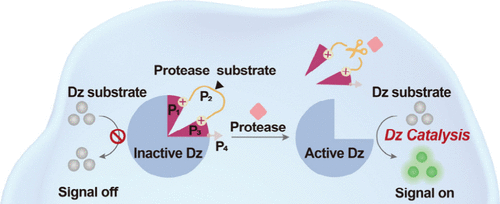
The in-depth integration of gene regulation with protein modulation can enhance cellular information processing, yet it is significantly constrained by ineffective and complex protein-to-gene transduction strategies. Herein, we developed a simple protease-guided autocatalytic gene silencing platform named iPAD (intelligent peptide-programmed deoxyribonuclease) that converts the protease recognition events into versatile DNA readout signals by rationally designing a native protease-responsive cationic peptide (PP) to efficiently modulate the DNAzyme (Dz) activity. Without requiring additional chemical modifications, the multifunctional PP regulator consists simply of one cell-specific targeting peptide segment and two cationic peptide segments isolated by one protease-specific peptide substrate. The catalytic activity of Dz can be potently disrupted via the cooperatively stabilized electrostatic interactions between cationic PP and the anionic Dz. Subsequently, the Dz activity is efficiently restored via the protease-specific cleavage of the PP, which disrupts the cooperative stabilization between PP and Dz, thus achieving robust and accurate monitoring of protease activity. Molecular dynamic simulations theoretically validate that the on-demand regulation of Dz activity was indeed acquired from the programmed oligomerization of oligo-peptides. As a universal protease sensing platform, this method was successfully applied to probe Caspase-3 and thrombin, facilitating the early evaluation of tumor therapeutic efficacy. Moreover, the endogenous Caspase-3-activated Dz facilitates the construction of an autocatalytic gene regulation platform that self-adaptively upregulates the expression of apoptotic proteases, accelerating tumor cell apoptosis. This simple yet intelligent iPAD system provides a versatile toolbox for high-performance biosensing and bioengineering applications, paving the way for new strategies in smart theragnostic research.
期刊介绍:
The flagship journal of the American Chemical Society, known as the Journal of the American Chemical Society (JACS), has been a prestigious publication since its establishment in 1879. It holds a preeminent position in the field of chemistry and related interdisciplinary sciences. JACS is committed to disseminating cutting-edge research papers, covering a wide range of topics, and encompasses approximately 19,000 pages of Articles, Communications, and Perspectives annually. With a weekly publication frequency, JACS plays a vital role in advancing the field of chemistry by providing essential research.



 求助内容:
求助内容: 应助结果提醒方式:

 京公网安备 11010802042870号


