Rebecca Grzadzinski, Raymond S Carpenter, Josh Rutsohn, Alapika Jatkar, Kattia Mata, Ambika Bhatt, Maria M Ortiz-Juza, Madison R Dennehey, Donna Gilleskie, Jed T Elison, Nicolas Pégard, Jose Rodriguez-Romaguera
{"title":"Pupil responses to social stimuli are associated with adaptive behaviors across the first 24 months of life.","authors":"Rebecca Grzadzinski, Raymond S Carpenter, Josh Rutsohn, Alapika Jatkar, Kattia Mata, Ambika Bhatt, Maria M Ortiz-Juza, Madison R Dennehey, Donna Gilleskie, Jed T Elison, Nicolas Pégard, Jose Rodriguez-Romaguera","doi":"10.1186/s11689-025-09628-2","DOIUrl":null,"url":null,"abstract":"<p><p>BACKGROUND: Pupil changes in response to well-controlled stimuli can be used to understand processes that regulate attention, learning, and arousal. This study investigates whether pupil dynamics to social stimuli are associated with concurrent adaptive behavior in typically developing infants. To accomplish this, we developed and assessed pupillary responses to Stimuli for Early Social Arousal and Motivation in Infants (SESAMI). METHODS: A sample of forty-six typically developing children aged six to twenty-four months were exposed to SESAMI. Infants were presented with either dynamic social faces or non-social stimuli that controlled for luminance, motion, and auditory exposure. A multi-level mixed effects model was used to fit pupillary response functions (PRFs) that measure the change in pupil size over time as the infants fixate on either a socially dynamic face or a non-social control. This model produces separate social and non-social PRFs for both the population and each individual. An average individual deviation score from the population PRF was calculated separately for social and non-social trials yielding the pupil response index (PRI). Vineland Adaptive Behavior Scales (VABS) were regressed on social and non-social individual PRIs while controlling for age and average fixation time. We tested whether the social PRI was a statistically significant predictor of adaptive behavior by comparing the model predicted VABS scores with observed scores. RESULTS: An increase in PRI to social stimuli was significantly associated with better adaptive behaviors in typically developing children between 6 and 24 months of age. CONCLUSIONS: SESAMI combined with pupillometry and multi-level mixed effects modeling, provides a novel and scalable framework for quantifying individual differences in pupil changes in response to social stimuli relative to a population-level baseline. By demonstrating that pupil response indices during social fixations predict adaptive behaviors, we lay the foundation to test how these measures may help identify infants with intellectual and developmental disorders. </p>","PeriodicalId":16530,"journal":{"name":"Journal of Neurodevelopmental Disorders","volume":"17 1","pages":"44"},"PeriodicalIF":3.6000,"publicationDate":"2025-08-01","publicationTypes":"Journal Article","fieldsOfStudy":null,"isOpenAccess":false,"openAccessPdf":"https://www.ncbi.nlm.nih.gov/pmc/articles/PMC12317559/pdf/","citationCount":"0","resultStr":null,"platform":"Semanticscholar","paperid":null,"PeriodicalName":"Journal of Neurodevelopmental Disorders","FirstCategoryId":"3","ListUrlMain":"https://doi.org/10.1186/s11689-025-09628-2","RegionNum":2,"RegionCategory":"医学","ArticlePicture":[],"TitleCN":null,"AbstractTextCN":null,"PMCID":null,"EPubDate":"","PubModel":"","JCR":"Q1","JCRName":"CLINICAL NEUROLOGY","Score":null,"Total":0}
引用次数: 0
Abstract
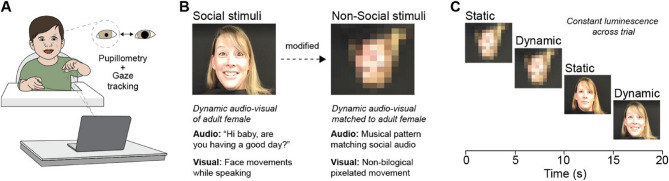
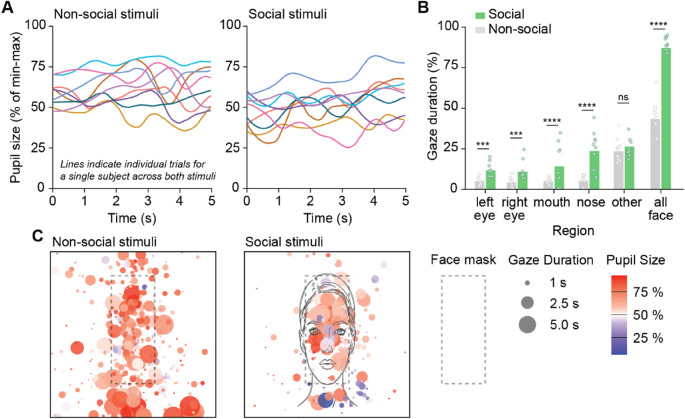
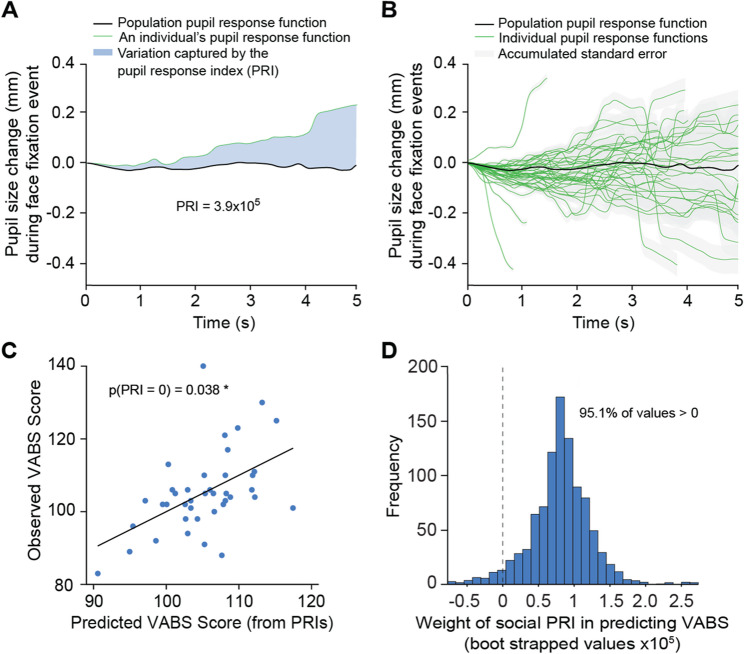
BACKGROUND: Pupil changes in response to well-controlled stimuli can be used to understand processes that regulate attention, learning, and arousal. This study investigates whether pupil dynamics to social stimuli are associated with concurrent adaptive behavior in typically developing infants. To accomplish this, we developed and assessed pupillary responses to Stimuli for Early Social Arousal and Motivation in Infants (SESAMI). METHODS: A sample of forty-six typically developing children aged six to twenty-four months were exposed to SESAMI. Infants were presented with either dynamic social faces or non-social stimuli that controlled for luminance, motion, and auditory exposure. A multi-level mixed effects model was used to fit pupillary response functions (PRFs) that measure the change in pupil size over time as the infants fixate on either a socially dynamic face or a non-social control. This model produces separate social and non-social PRFs for both the population and each individual. An average individual deviation score from the population PRF was calculated separately for social and non-social trials yielding the pupil response index (PRI). Vineland Adaptive Behavior Scales (VABS) were regressed on social and non-social individual PRIs while controlling for age and average fixation time. We tested whether the social PRI was a statistically significant predictor of adaptive behavior by comparing the model predicted VABS scores with observed scores. RESULTS: An increase in PRI to social stimuli was significantly associated with better adaptive behaviors in typically developing children between 6 and 24 months of age. CONCLUSIONS: SESAMI combined with pupillometry and multi-level mixed effects modeling, provides a novel and scalable framework for quantifying individual differences in pupil changes in response to social stimuli relative to a population-level baseline. By demonstrating that pupil response indices during social fixations predict adaptive behaviors, we lay the foundation to test how these measures may help identify infants with intellectual and developmental disorders.
期刊介绍:
Journal of Neurodevelopmental Disorders is an open access journal that integrates current, cutting-edge research across a number of disciplines, including neurobiology, genetics, cognitive neuroscience, psychiatry and psychology. The journal’s primary focus is on the pathogenesis of neurodevelopmental disorders including autism, fragile X syndrome, tuberous sclerosis, Turner Syndrome, 22q Deletion Syndrome, Prader-Willi and Angelman Syndrome, Williams syndrome, lysosomal storage diseases, dyslexia, specific language impairment and fetal alcohol syndrome. With the discovery of specific genes underlying neurodevelopmental syndromes, the emergence of powerful tools for studying neural circuitry, and the development of new approaches for exploring molecular mechanisms, interdisciplinary research on the pathogenesis of neurodevelopmental disorders is now increasingly common. Journal of Neurodevelopmental Disorders provides a unique venue for researchers interested in comparing and contrasting mechanisms and characteristics related to the pathogenesis of the full range of neurodevelopmental disorders, sharpening our understanding of the etiology and relevant phenotypes of each condition.

 求助内容:
 应助结果提醒方式:


 京公网安备 11010802042870号


