Tommaso Violante, Sacha P Broccard, Marco Novelli, Luca Stocchi, Dorin T Colibaseanu, Michelle F DeLeon, Kevin T Behm, Nitin Mishra, David W Larson, Amit Merchea
{"title":"Comparative analysis of robotic, laparoscopic, and open ileal pouch-anal anastomosis outcomes: retrospective cohort study.","authors":"Tommaso Violante, Sacha P Broccard, Marco Novelli, Luca Stocchi, Dorin T Colibaseanu, Michelle F DeLeon, Kevin T Behm, Nitin Mishra, David W Larson, Amit Merchea","doi":"10.1093/bjsopen/zraf084","DOIUrl":null,"url":null,"abstract":"<p><strong>Introduction: </strong>Ileal pouch-anal anastomosis (IPAA) is a common surgical procedure for patients with ulcerative colitis or familial adenomatous polyposis. This study compared the outcomes of robotic, laparoscopic, and open IPAA techniques, with a focus on surgical complications and pouch failure rates.</p><p><strong>Methods: </strong>A retrospective study was conducted of patients who underwent IPAA at three Mayo Clinic locations between 2015 and 2020. Data on patient demographics, surgical details, and postoperative outcomes were collected and compared across the three surgical approaches. Pouch failure was defined as the need for pouch excision or a diverting loop ileostomy.</p><p><strong>Results: </strong>In all, 401 patients underwent IPAA with either an open (149, 37.2%), robotic (145, 36.2%), or laparoscopic (107, 26.7%) technique. The overall rate of pouch failure was 6.5% and did not differ significantly between the three surgical approaches. Compared with laparoscopy, robotic IPAA was associated with a lower conversion rate to open surgery (1.4 versus 17.8%; P < 0.0001) and fewer 30-day readmissions (15.9% versus 28.0%; P = 0.02). However, robotic and laparoscopic IPAA approaches had higher rates of venous thromboembolism/pulmonary embolism and readmission than the open approach. Pouchitis was the most common cause of pouch failure across all surgical techniques.</p><p><strong>Conclusion: </strong>Robotic IPAA had lower conversion and reduced 30-day admission rates compared with a laparoscopic approach. However, open surgery had lower rates of 30-day readmission and rates thromboembolism than robotic IPAA. The surgical approach itself does not appear to significantly impact long-term pouch failure rates.</p>","PeriodicalId":9028,"journal":{"name":"BJS Open","volume":"9 4","pages":""},"PeriodicalIF":4.5000,"publicationDate":"2025-07-01","publicationTypes":"Journal Article","fieldsOfStudy":null,"isOpenAccess":false,"openAccessPdf":"https://www.ncbi.nlm.nih.gov/pmc/articles/PMC12312352/pdf/","citationCount":"0","resultStr":null,"platform":"Semanticscholar","paperid":null,"PeriodicalName":"BJS Open","FirstCategoryId":"3","ListUrlMain":"https://doi.org/10.1093/bjsopen/zraf084","RegionNum":3,"RegionCategory":"医学","ArticlePicture":[],"TitleCN":null,"AbstractTextCN":null,"PMCID":null,"EPubDate":"","PubModel":"","JCR":"Q1","JCRName":"SURGERY","Score":null,"Total":0}
引用次数: 0
Abstract
Introduction: Ileal pouch-anal anastomosis (IPAA) is a common surgical procedure for patients with ulcerative colitis or familial adenomatous polyposis. This study compared the outcomes of robotic, laparoscopic, and open IPAA techniques, with a focus on surgical complications and pouch failure rates.
Methods: A retrospective study was conducted of patients who underwent IPAA at three Mayo Clinic locations between 2015 and 2020. Data on patient demographics, surgical details, and postoperative outcomes were collected and compared across the three surgical approaches. Pouch failure was defined as the need for pouch excision or a diverting loop ileostomy.
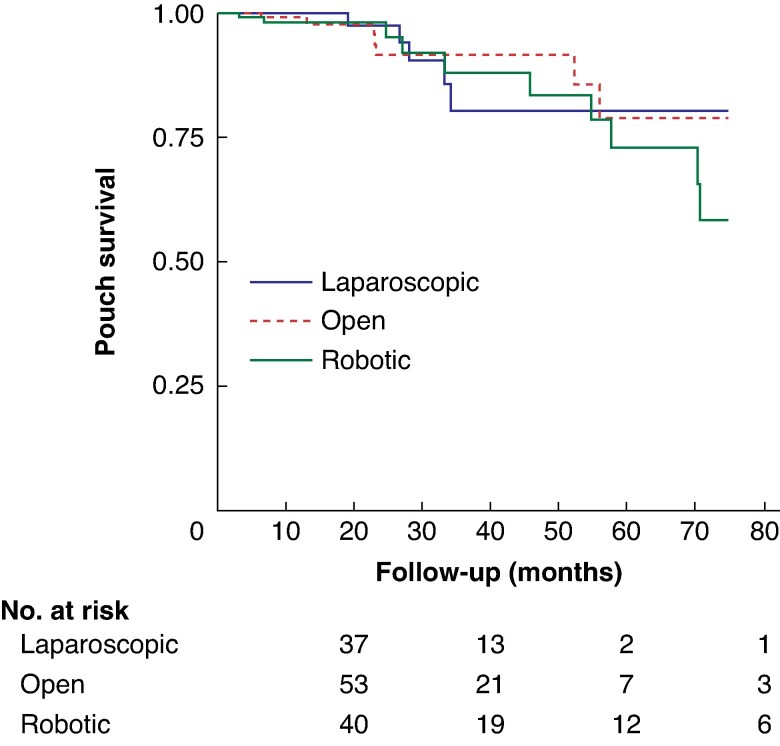
Results: In all, 401 patients underwent IPAA with either an open (149, 37.2%), robotic (145, 36.2%), or laparoscopic (107, 26.7%) technique. The overall rate of pouch failure was 6.5% and did not differ significantly between the three surgical approaches. Compared with laparoscopy, robotic IPAA was associated with a lower conversion rate to open surgery (1.4 versus 17.8%; P < 0.0001) and fewer 30-day readmissions (15.9% versus 28.0%; P = 0.02). However, robotic and laparoscopic IPAA approaches had higher rates of venous thromboembolism/pulmonary embolism and readmission than the open approach. Pouchitis was the most common cause of pouch failure across all surgical techniques.
Conclusion: Robotic IPAA had lower conversion and reduced 30-day admission rates compared with a laparoscopic approach. However, open surgery had lower rates of 30-day readmission and rates thromboembolism than robotic IPAA. The surgical approach itself does not appear to significantly impact long-term pouch failure rates.



 求助内容:
求助内容: 应助结果提醒方式:

 京公网安备 11010802042870号


