Metabolomics and serum pharmacochemistry combined with network pharmacology uncover the potential effective ingredients and mechanisms of Yin-Chen-Si-Ni Decoction treating ANIT-induced cholestatic liver injury
{"title":"Metabolomics and serum pharmacochemistry combined with network pharmacology uncover the potential effective ingredients and mechanisms of Yin-Chen-Si-Ni Decoction treating ANIT-induced cholestatic liver injury","authors":"Yanru Liu , Hui Chen , Gongjun Yang , Fang Feng","doi":"10.1016/j.jep.2024.118713","DOIUrl":null,"url":null,"abstract":"<div><h3>Ethnopharmacological relevance</h3><p>Yin-Chen-Si-Ni Decoction is a classical traditional Chinese medicine (TCM) prescription that is used clinically for treating cholestatic liver injury (CLI) and other hepatic diseases. However, the material basis and underlying mechanisms of YCSND are not clear.</p><p><em>Aim of the study</em>: To investigate effective components and mechanisms of YCSND in the treatment of CLI using serum pharmacochemistry, metabolomics, and network pharmacology.</p></div><div><h3>Materials and methods</h3><p>Biochemical indicators, liver index, and histopathology analysis were adopted to evaluate the protective effect of YCSND on ANIT-induced CLI rats. Then, a UPLC-Q-Exactive Orbitrap MS/MS analysis of the migrant components in serum and liver including prototype and metabolic components was performed in YCSND. In addition, a study of the endogenous metabolites using serum and liver metabolomics was performed to discover potential biomarkers, metabolic pathways, and associated mechanisms. Further, the network pharmacology oriented by <em>in vivo</em> migrant components was also used to pinpoint the active ingredients, core targets, and signaling pathways of YCSND. Finally, molecular docking and molecular dynamics simulation (MDS) were used to predict the binding ability between components and core targets, and a real-time qPCR (RT-qPCR) experiment was used to measure the mRNA expression of the core target genes.</p></div><div><h3>Results</h3><p>Pharmacodynamic studies suggest that YCSND could exert obvious hepatoprotective effects on CLI rats. Furthermore, 68 compounds, comprising 32 prototype components and 36 metabolic components from YCSND, were found by serum pharmacochemistry analysis. Network pharmacology combining molecular docking and MDS showed that apigenin, naringenin, 18β-glycyrrhetinic acid, and isoformononetin have better binding ability to 6 core targets (EGFR, AKT1, IL6, MMP9, CASP3, PPARG). Additionally, PI3K, TNF-α, MAPK3, and six core target genes in liver tissues were validated with RT-qPCR. Metabolomics revealed the anti-CLI effects of YCSND by regulating four metabolic pathways of primary bile acid and biosynthesis, phenylalanine, tyrosine and tryptophan biosynthesis, taurine and hypotaurine metabolism, and arachidonic acid metabolism. Integrating metabolomics and network pharmacology identified four pathways related to CLI, including the PI3K-Akt, HIF-1, MAPK, and TNF signaling pathway, which revealed multiple mechanisms of YCSND against CLI that might involve anti-inflammatory and apoptosis.</p></div><div><h3>Conclusion</h3><p>The research based on serum pharmacochemistry, network pharmacology, and metabolomics demonstrates the beneficial hepatoprotective effects of YCSND on CLI rats by regulating multiple components, multiple targets, and multiple pathways, and provides a potent means of illuminating the material basis and mechanisms of TCM prescriptions.</p></div>","PeriodicalId":15761,"journal":{"name":"Journal of ethnopharmacology","volume":"335 ","pages":"Article 118713"},"PeriodicalIF":6.8000,"publicationDate":"2024-12-05","publicationTypes":"Journal Article","fieldsOfStudy":null,"isOpenAccess":false,"openAccessPdf":"","citationCount":"0","resultStr":null,"platform":"Semanticscholar","paperid":null,"PeriodicalName":"Journal of ethnopharmacology","FirstCategoryId":"3","ListUrlMain":"https://www.sciencedirect.com/science/article/pii/S0378874124010122","RegionNum":2,"RegionCategory":"医学","ArticlePicture":[],"TitleCN":null,"AbstractTextCN":null,"PMCID":null,"EPubDate":"2024/8/18 0:00:00","PubModel":"Epub","JCR":"Q1","JCRName":"CHEMISTRY, MEDICINAL","Score":null,"Total":0}
引用次数: 0
Abstract
Ethnopharmacological relevance
Yin-Chen-Si-Ni Decoction is a classical traditional Chinese medicine (TCM) prescription that is used clinically for treating cholestatic liver injury (CLI) and other hepatic diseases. However, the material basis and underlying mechanisms of YCSND are not clear.
Aim of the study: To investigate effective components and mechanisms of YCSND in the treatment of CLI using serum pharmacochemistry, metabolomics, and network pharmacology.
Materials and methods
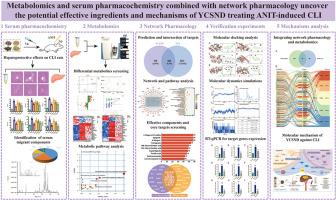
Biochemical indicators, liver index, and histopathology analysis were adopted to evaluate the protective effect of YCSND on ANIT-induced CLI rats. Then, a UPLC-Q-Exactive Orbitrap MS/MS analysis of the migrant components in serum and liver including prototype and metabolic components was performed in YCSND. In addition, a study of the endogenous metabolites using serum and liver metabolomics was performed to discover potential biomarkers, metabolic pathways, and associated mechanisms. Further, the network pharmacology oriented by in vivo migrant components was also used to pinpoint the active ingredients, core targets, and signaling pathways of YCSND. Finally, molecular docking and molecular dynamics simulation (MDS) were used to predict the binding ability between components and core targets, and a real-time qPCR (RT-qPCR) experiment was used to measure the mRNA expression of the core target genes.
Results
Pharmacodynamic studies suggest that YCSND could exert obvious hepatoprotective effects on CLI rats. Furthermore, 68 compounds, comprising 32 prototype components and 36 metabolic components from YCSND, were found by serum pharmacochemistry analysis. Network pharmacology combining molecular docking and MDS showed that apigenin, naringenin, 18β-glycyrrhetinic acid, and isoformononetin have better binding ability to 6 core targets (EGFR, AKT1, IL6, MMP9, CASP3, PPARG). Additionally, PI3K, TNF-α, MAPK3, and six core target genes in liver tissues were validated with RT-qPCR. Metabolomics revealed the anti-CLI effects of YCSND by regulating four metabolic pathways of primary bile acid and biosynthesis, phenylalanine, tyrosine and tryptophan biosynthesis, taurine and hypotaurine metabolism, and arachidonic acid metabolism. Integrating metabolomics and network pharmacology identified four pathways related to CLI, including the PI3K-Akt, HIF-1, MAPK, and TNF signaling pathway, which revealed multiple mechanisms of YCSND against CLI that might involve anti-inflammatory and apoptosis.
Conclusion
The research based on serum pharmacochemistry, network pharmacology, and metabolomics demonstrates the beneficial hepatoprotective effects of YCSND on CLI rats by regulating multiple components, multiple targets, and multiple pathways, and provides a potent means of illuminating the material basis and mechanisms of TCM prescriptions.
期刊介绍:
The Journal of Ethnopharmacology is dedicated to the exchange of information and understandings about people''s use of plants, fungi, animals, microorganisms and minerals and their biological and pharmacological effects based on the principles established through international conventions. Early people confronted with illness and disease, discovered a wealth of useful therapeutic agents in the plant and animal kingdoms. The empirical knowledge of these medicinal substances and their toxic potential was passed on by oral tradition and sometimes recorded in herbals and other texts on materia medica. Many valuable drugs of today (e.g., atropine, ephedrine, tubocurarine, digoxin, reserpine) came into use through the study of indigenous remedies. Chemists continue to use plant-derived drugs (e.g., morphine, taxol, physostigmine, quinidine, emetine) as prototypes in their attempts to develop more effective and less toxic medicinals.

 求助内容:
求助内容: 应助结果提醒方式:

 京公网安备 11010802042870号


