
Luminescent sensor based on colloidal Ag2S quantum dots for oxytetracycline detection in milk
IF 4.6
2区 化学
Q1 SPECTROSCOPY
Spectrochimica Acta Part A: Molecular and Biomolecular Spectroscopy
Pub Date : 2026-05-15
Epub Date: 2026-02-06
DOI:10.1016/j.saa.2026.127551
引用次数: 0
Abstract
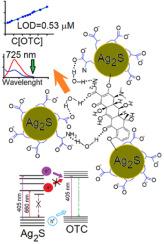
The paper presents the study results of luminescent sensor, based on colloidal AgS quantum dots, passivated with L-cysteine molecules (AgS/L-Cys QDs) for oxytetracycline (OTC) detection in raw milk. Its work is based on QDs luminescence quenching in the spectral region, which is free from the intrinsic luminescence of the raw milk and OTC (725 nm). A working sensor mechanism was proposed. It is based on the formation of a non-luminescent complex with charge transfer between OTC and AgS/L-Cys QDs due to binding the antibiotic with passivator. The sensor parameters were established. The limit of detection (LOD) is 0.53 M in milk, limit of quantitative detection (LOQ) is 1.16 M, linear range is 0–20 M. These parameters are comparable with known luminescent sensor analogs for raw milk.
胶体Ag2S量子点发光传感器用于牛奶中土霉素的检测
本文介绍了用l -半胱氨酸分子(Ag2S/L-Cys量子点)钝化胶体Ag2S量子点发光传感器检测原料奶中土霉素(OTC)的研究结果。它的工作是基于量子点在光谱区域的发光猝灭,该区域不受原料牛奶和OTC (725 nm)的固有发光的影响。提出了一种工作传感器机构。它的基础是由于抗生素与钝化剂结合,OTC与Ag2S/L-Cys量子点之间形成非发光配合物,并发生电荷转移。建立了传感器参数。牛奶的检出限为0.53 μM,定量限为1.16 μM,线性范围为0 ~ 20 μM。这些参数与已知的原料牛奶的发光传感器类似物相当。
本文章由计算机程序翻译,如有差异,请以英文原文为准。
求助全文
约1分钟内获得全文
求助全文
来源期刊
CiteScore
8.40
自引率
11.40%
发文量
1364
审稿时长
40 days
期刊介绍:
Spectrochimica Acta, Part A: Molecular and Biomolecular Spectroscopy (SAA) is an interdisciplinary journal which spans from basic to applied aspects of optical spectroscopy in chemistry, medicine, biology, and materials science.
The journal publishes original scientific papers that feature high-quality spectroscopic data and analysis. From the broad range of optical spectroscopies, the emphasis is on electronic, vibrational or rotational spectra of molecules, rather than on spectroscopy based on magnetic moments.
Criteria for publication in SAA are novelty, uniqueness, and outstanding quality. Routine applications of spectroscopic techniques and computational methods are not appropriate.
Topics of particular interest of Spectrochimica Acta Part A include, but are not limited to:
Spectroscopy and dynamics of bioanalytical, biomedical, environmental, and atmospheric sciences,
Novel experimental techniques or instrumentation for molecular spectroscopy,
Novel theoretical and computational methods,
Novel applications in photochemistry and photobiology,
Novel interpretational approaches as well as advances in data analysis based on electronic or vibrational spectroscopy.
 求助内容:
求助内容: 应助结果提醒方式:

 京公网安备 11010802042870号


